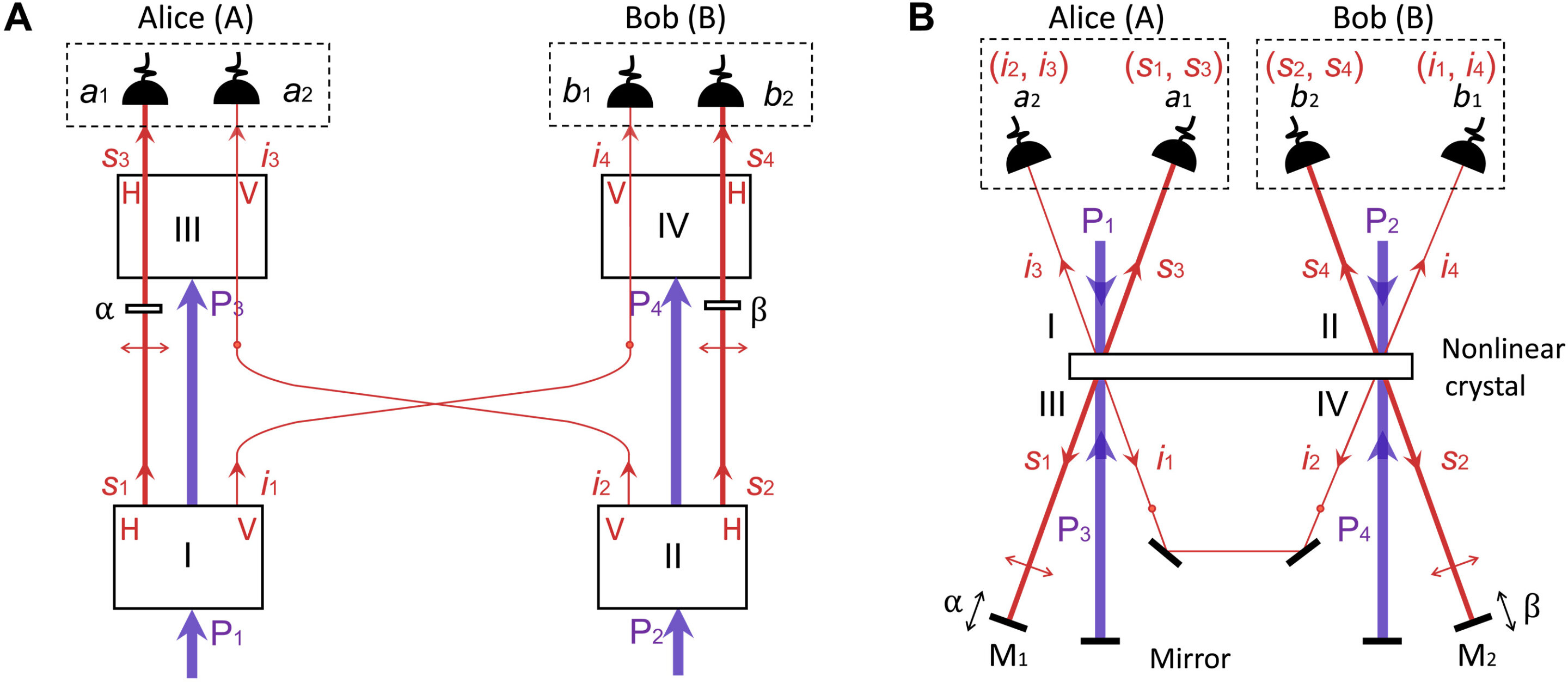
New theoretical work shows that the indistinguishability of identical particles can produce detectable nonlocal correlations even in passive optical setups, suggesting a universal entanglement resource at the heart of quantum mechanics.
Polish physicists have demonstrated that quantum nonlocality may be an inherent property of identical particles, arising from their fundamental indistinguishability, and can be observed experimentally even without direct interaction, suggesting that nonlocality is woven into the fabric of the universe.
Physicists have successfully demonstrated a quantum 'lie detector' by testing Bell correlations in a 73-qubit system, confirming genuine quantum behavior in large, complex systems, which advances the development of truly quantum computers and quantum technologies.
Scientists have demonstrated quantum correlations similar to entanglement without using entangled particles, by exploiting quantum indistinguishability, challenging traditional views and opening new avenues for quantum research.
A recent study published in Physical Review A has proposed a theoretical framework for attaining a higher nonlocal probability using quantum computers and methods to investigate the measurement of Hardy nonlocality. The study discovered that nonlocal probability increases as the number of particles grows, suggesting that quantum effects persist even at larger scales, further challenging classical theories of physics. Understanding quantum nonlocality can lead to groundbreaking technological advancements, such as the secure transmission of information through quantum communication via nonlocality resources.