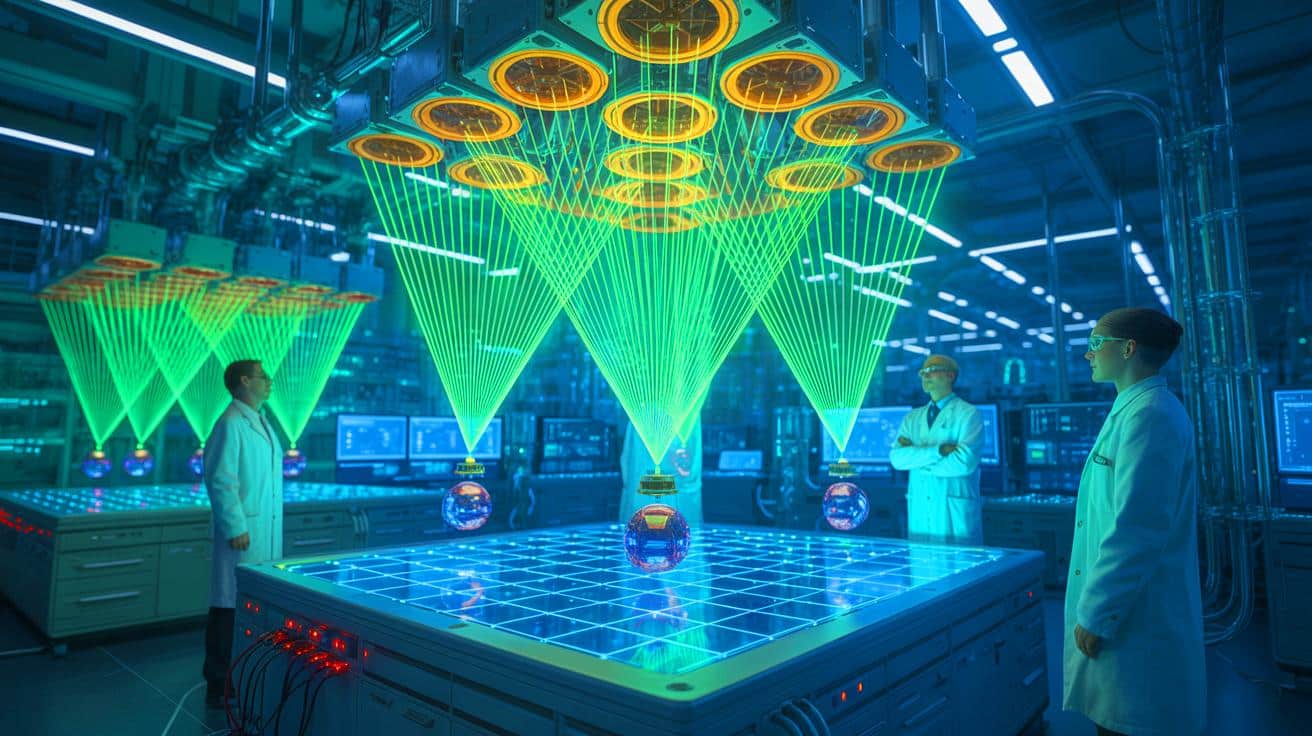
Caltech physicists have created the largest array of neutral-atom qubits, consisting of 6,100 qubits with high accuracy and the ability to move atoms while preserving superposition, marking a significant step toward scalable quantum computers capable of complex computations and simulations.

IonQ, a quantum computing company, is downgraded to a hold rating due to doubts about the scalability of its trapped ion qubit technology to achieve quantum advantage or supremacy. The company is exploring markets where its computers may outperform existing classical computers and is considering reducing the qubits needed for specific problems. IonQ's CEO hinted at a potential shift towards a more scalable qubit technology, possibly neutral atom qubits, as the company's current technology may not scale sufficiently. The article discusses the challenges and potential of various qubit technologies, highlighting the rapidly evolving landscape of quantum computing.
Researchers are exploring the potential of neutral-atom qubits for quantum computing, with recent advancements showing promise in terms of scalability and coherence times. Unlike ions, neutral atoms do not repel each other, making them more scalable and easier to entangle in a two-dimensional grid. Additionally, by boosting the size of atoms into Rydberg states, the interaction distance between atoms can be dramatically increased, potentially enabling significant progress in quantum computing.