
Bitcoin has entered a consolidation phase after a recent correction, trading around $96,431.49. Key metrics, including the Seller Exhaustion Composite and whale accumulation, suggest a potential bullish rally towards $100k. Analysts point to a falling wedge pattern and increased whale reserves as indicators of market confidence. However, Bitcoin must breach the $99k resistance to achieve a triple-digit value, with the Pi Cycle top indicator suggesting a possible market top above $123k or a drop to $68k if the current price isn't the bottom.
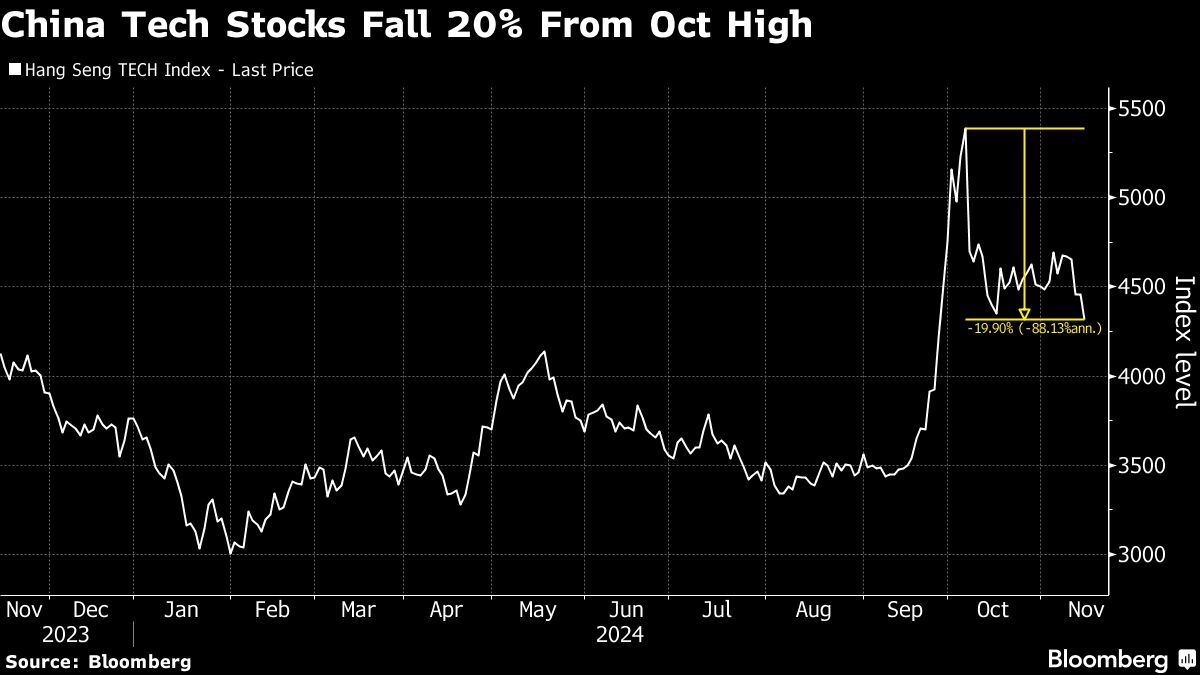
Chinese tech stocks in Hong Kong have slumped by about 20% from their October highs due to rising geopolitical risks and investor caution ahead of key earnings reports. The Hang Seng Tech Index fell 3.2%, with JD.com and Xiaomi contributing significantly to the decline. Concerns over potential Sino-American tensions under the Trump administration and profit-taking from a stimulus-driven rally have also contributed to the sell-off. Despite Tencent's strong earnings, broader market sentiment remains cautious.
Amid a 5% drop in Bitcoin's price following rumors of a delayed U.S. spot bitcoin ETF launch, social media "Buy the Dip" mentions surged to their highest point since March 2021, according to Santiment data. This increase in mentions typically indicates bullish sentiment among traders, although historically it has also preceded further price declines. Despite the initial drop, Bitcoin recovered slightly, trading at $43,200 with a 0.8% gain on the day.
Asian stocks declined as traders scaled back expectations for early and significant U.S. Federal Reserve rate cuts, following the release of the Fed's December meeting minutes which suggested a cautious approach to monetary policy. The minutes indicated concerns about overly restrictive policy impacting the economy and a lack of clear signals on when rate cuts might commence. This led to a decrease in the probability of a March rate cut from 90% to 70%, as per the CME FedWatch tool. Investors are now anticipating less easing this year, with futures pricing in under 150 basis points of cuts compared to 160 bps previously expected. Meanwhile, U.S. nonfarm payrolls data is awaited for further labor market insights, and China's service sector showed expansion, contrasting with official data indicating a contraction.
Jim Cramer, a long-time cryptocurrency skeptic, has acknowledged Bitcoin's resilience on CNBC, calling it a "technological marvel" and recognizing its permanence despite the SEC's opposition. This comes as Bitcoin surpassed $45,000 for the first time since April 2022. Cramer's history of inaccurate predictions has led to an "Inverse Cramer" meme, where people do the opposite of his advice. His recent positive remarks on Bitcoin have stirred concern among some crypto enthusiasts, given his track record. However, Cramer's newfound appreciation for Bitcoin does not extend to the entire crypto market.
The year started with cautious market sentiment as oil prices rose due to tensions in the Red Sea and weak Chinese manufacturing data affected Asian stocks. US equity futures remained stable, while European stocks saw a slight increase. The situation in the Red Sea escalated after Iran sent a warship following the US Navy's action against Houthi boats. Meanwhile, Bitcoin's value increased with the prospect of an ETF approval. In Asia, market sentiment was further impacted by the US pressuring the Netherlands to halt shipments of chip-making equipment to China. Upcoming economic data releases and central bank communications are anticipated to guide market directions in the short term.