The article examines whether the current AI-driven stock market rally resembles a bubble, comparing it to past market bubbles and analyzing factors like valuation, concentration, fundamentals, and investor scrutiny. While some indicators suggest overvaluation and high concentration in tech stocks, historical context and company fundamentals imply that a crash isn't imminent, though increased scrutiny remains a healthy check on potential risks.
Nvidia, a leading AI chipmaker valued at over $4tn, faces investor scrutiny over its complex and circular deals with AI companies like OpenAI, which resemble vendor financing and raise concerns about sustainability and transparency, especially amid large government and international partnerships. While Nvidia denies similarities to Enron or Lucent, analysts warn that reliance on such financing structures could pose risks if AI growth slows, potentially impacting its financial stability and global economic influence.
Beyond Meat's shares fell below $1 due to investor concerns over its plan to issue more shares to reduce debt, amid ongoing struggles with weak demand and declining sales, leading to a significant stock decline and potential delisting risk.
Beyond Meat's shares fell below $1 due to investor concerns over its plan to issue new shares to reduce debt, amid ongoing struggles with weak demand and declining sales, especially in the U.S., leading to fears of delisting from Nasdaq.
Enthusiasm for AI has driven the stock market to record highs, with concerns mounting about a potential bubble due to high valuations, market concentration, and circular financing, although some analysts note that current profits from mega-cap tech companies differentiate this rally from the dot-com bubble. Experts warn of risks if AI expectations falter, and the market's heavy reliance on a few big tech stocks raises vulnerability to a downturn.
An investor and climate advocate has proposed that Tesla adopt a policy of political neutrality to prevent political statements by its leaders from affecting the company's reputation and sales, especially amid concerns about Elon Musk's political activities. The Tesla board opposes the proposal, citing enforcement challenges, while many retail investors are increasingly questioning Musk's political involvement and its impact on Tesla's market performance, particularly in politically sensitive regions like California.
While tariffs and trade policies are causing short-term volatility in the stock market, a more significant and overlooked risk is the high valuation levels combined with poor earnings quality among major companies, which could lead to a market correction.
Shares of Novo Nordisk fell up to 3.5% after trial data for its experimental obesity drug CagriSema raised investor concerns about its competitiveness against Eli Lilly, with questions about tolerability and market timing impacting investor confidence amid ongoing competition in the obesity market.
The U.S. stock market is experiencing a rare and concerning phenomenon known as 'bad breadth,' where more stocks are falling than rising despite the S&P 500's continued climb. This situation, not seen in over 20 years, is reminiscent of the period around September 11, 2001. While megacap technology stocks are currently offsetting broader market weakness, the narrow market breadth is causing investor anxiety. Historically, such weak breadth has coincided with significant market downturns, raising concerns about potential future declines.
Super Micro Computer's stock experienced a significant decline despite reassurances from the company's CEO. The drop in share price suggests that investors remain concerned about the company's future prospects, possibly due to broader market conditions or specific company challenges.
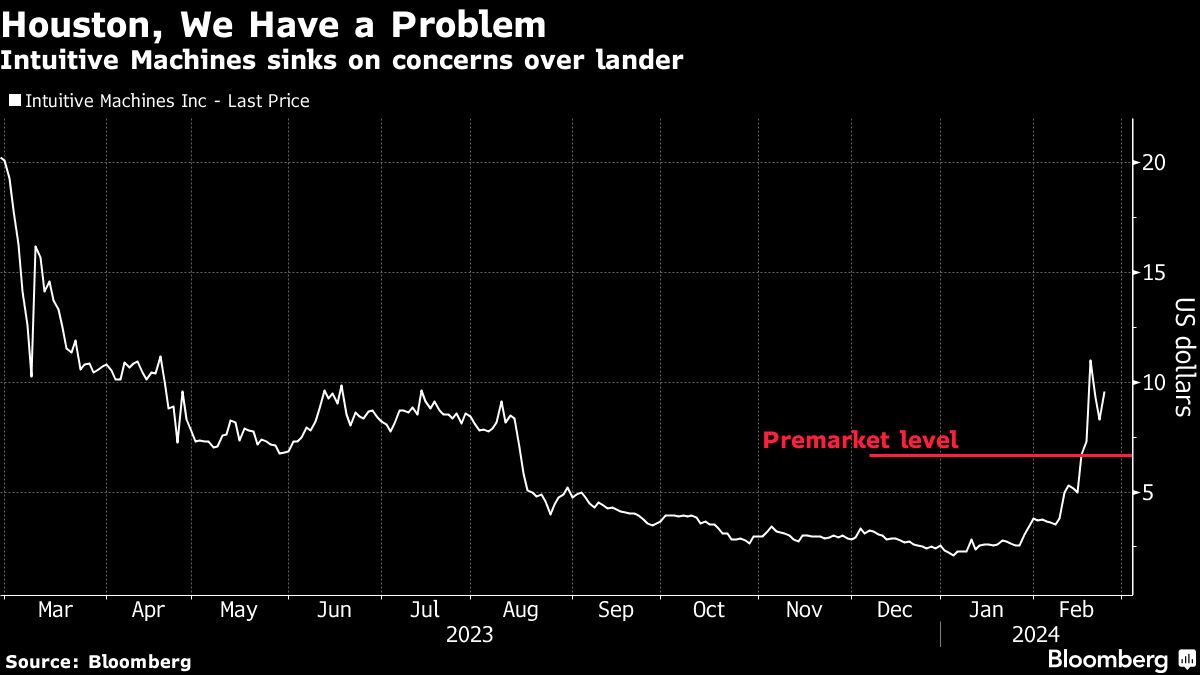
Intuitive Machines Inc. shares plummeted in premarket trading after the company revealed that its moon lander likely touched down on its side, causing heavy investor interest and a more than 25% drop in stock value. The landing, initially celebrated as a milestone, was later corrected by the company due to faulty data. Despite recent excitement over the mission, the stock had seen significant gains this year but lost about three-fourths of its value over the course of 2023.
The Walt Disney Company is set to report its fiscal first-quarter results, addressing investor concerns over streaming losses and its slumping share price. Analysts expect earnings per share of 99 cents and revenue of $23.64 billion. The board is facing renewed pressure from activist investor Nelson Peltz, who is pushing for a shake-up and citing the company's stock plunge and disappointing studio content. CEO Bob Iger has vowed to rely less on sequels and more on fresh, quality films, but the impact may not be seen until 2025 or 2026 due to production timelines. Disney's new financial reporting structure segments the company into three divisions: entertainment, sports, and experiences.
Oracle Corp. reported disappointing sales growth in its cloud computing business, with cloud revenue rising 25% in the latest quarter, compared to a 30% gain in the previous quarter. This slowdown has raised concerns among investors about Oracle's ability to compete in the competitive cloud market. The company remains optimistic, citing strong customer demand.
Oracle reported slowing sales growth in its cloud computing business, causing investor concerns about its ability to compete in the market. Cloud revenue rose 25% in the quarter, marking the second consecutive quarter of slowing growth. The company is focused on expanding its cloud infrastructure business to compete with Amazon, Microsoft, and Google. While Oracle executives remain optimistic about the business, investors are waiting to see improvement. The availability of graphics processors used in data centers will also impact future gains. Oracle's shares fell about 8% in extended trading following the announcement.
Weight loss drugs, particularly GLP-1 agonists like Wegovy, Ozempic, and Mounjaro, were a major topic of discussion during Q3 earnings calls for healthcare and consumer companies. Analysts raised questions about the potential impact of these drugs on sales, leading to a significant increase in mentions compared to the previous quarter. Companies had to address whether the popularity of these drugs would be positive or negative for their business. GLP-1 agonists have proven effective in treating diabetes and weight loss, and investor interest in the topic has been growing. However, concerns about the potential effects on consumer behavior and the market performance of related industries, such as sugary food sellers and medical device makers, have also emerged. Despite uncertainties, these drugs are expected to become the best-selling drug class in the pharmaceutical industry.