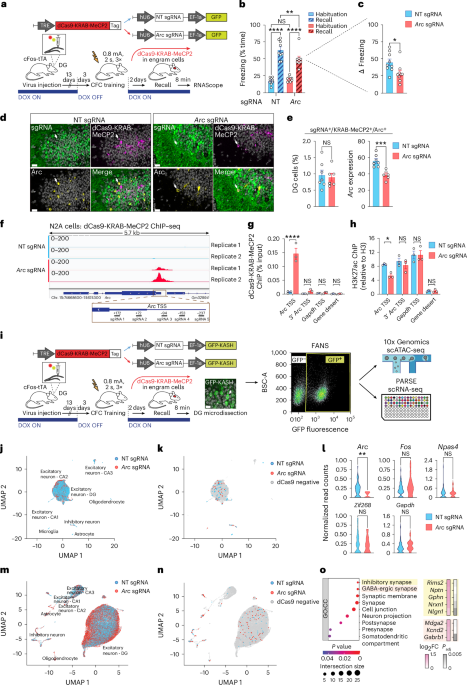
This study developed cell-type- and locus-specific epigenetic editing tools using CRISPR-dCas9 to modulate memory expression in engram cells, demonstrating that targeted epigenetic modifications at the Arc gene locus can bidirectionally regulate memory formation and retention in mice, with effects that are reversible and applicable beyond initial memory consolidation.

A recent study led by neuroscientist Dr. Tomás Ryan and his team has revealed new insights into the brain's learning mechanisms. The study found that learning involves the formation of new connectivity patterns between specific engram cells in different brain regions. These memory engram cells change themselves to hold information and trigger recall of associated experiences. The research identified a molecular mechanism involving a protein in the synapse that regulates connectivity between engram cells, suggesting changes in synaptic wiring as a likely mechanism for memory storage. Understanding these cellular mechanisms helps advance knowledge of how the brain processes thoughts and information.
Neuroscientists from Trinity College Dublin have discovered that memory formation occurs through the continuous creation of new connectivity patterns between specific engram cells in different brain regions. Engram cells are activated by experiences and change to hold information in our brains. The researchers used genetic techniques and optogenetics to study how engram cells form connections and identified a protein involved in regulating this connectivity. This study sheds light on the mechanism behind memory storage in the brain and provides insights into how we learn and remember.