Tag

Complex Systems

All articles tagged with #complex systems

science2 years ago

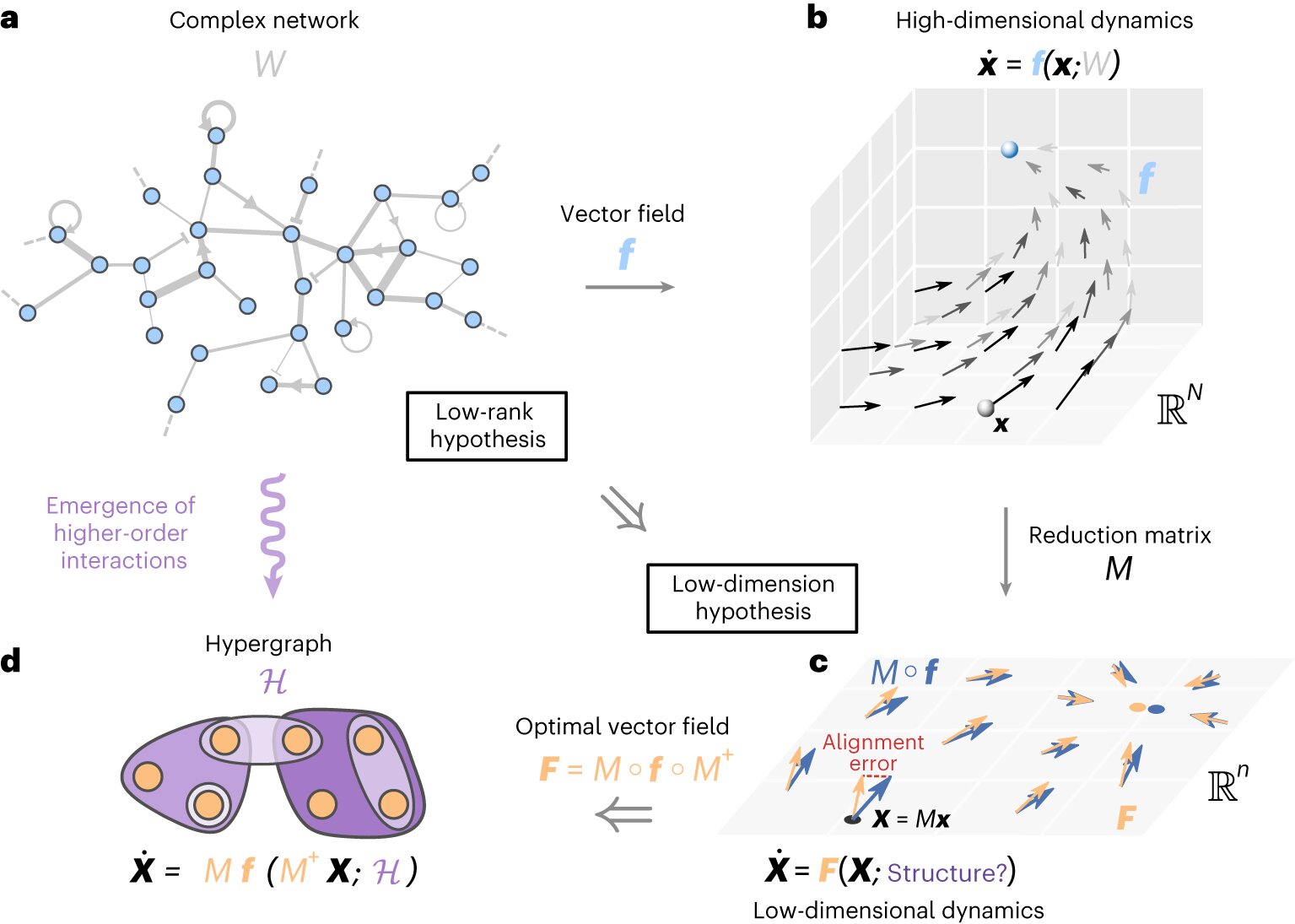
"Confirming the Low-Rank Hypothesis in Complex Systems"

Scientists have investigated the low-rank hypothesis in complex systems, finding that despite high-dimensional nonlinear dynamics, many real networks exhibit rapidly decreasing singular values, supporting the feasibility of effective dimension reduction for understanding and modeling complex system behaviors. The study, published in Nature Physics, aims to address the challenge of understanding large-scale behavior in complex systems by exploring the intrinsic simplicity of these systems and finding an optimal dimension for simplifying models. The researchers sought to validate the low-rank hypothesis using singular value decomposition, a powerful mathematical tool from linear algebra.

science-and-astronomy2 years ago

"Scientists Unveil Groundbreaking Law Explaining Universal Evolution"

Scientists have proposed a "missing" scientific law called the "law of increasing functional information" that applies to the evolution of life, minerals, planets, stars, and other systems in the universe. The law states that systems evolve and become more complex over time when different configurations undergo selection for one or more functions. This law expands on Darwin's theory of evolution by suggesting that non-living systems also evolve based on improved function. While some scientists praise the study as transformative, others argue that the emergence of diverse materials and structures in the inanimate world does not require a new underlying principle.

science2 years ago

"Uncovering the Elusive Law of Evolution: Insights from Scientists and Philosophers"

Scientists and philosophers have identified a missing law of nature that recognizes evolution as a common feature of complex systems in the natural world. The "Law of Increasing Functional Information" states that complex systems evolve to states of greater patterning, diversity, and complexity through selection for function. This law applies to various systems, including life, stars, atoms, minerals, and more. The research expands on Darwinian evolution and offers insights into the generative forces behind complex phenomena in the universe. It also has implications for understanding the potential complexity of evolving systems, influencing the rate of evolution, and aiding the search for life elsewhere.

science-and-technology2 years ago

The Hidden Math Behind Global Control.

Network science, a branch of mathematics that studies complex systems, has revealed that many real-world networks, such as the internet and metabolic networks, follow a scale-free architecture rather than a random one. This means that they are not governed by averages and that hubs, or highly connected nodes, emerge naturally. The growth of these networks is driven by preferential attachment, meaning that new nodes tend to connect to already highly connected nodes. Network science offers a framework for understanding the architecture of complex systems that emerge from the interaction of many components.

science2 years ago

50-year-old puzzle of network stability solved by Israeli researchers

Researchers from Bar-Ilan University in Israel have solved the diversity-stability paradox, a 50-year-old puzzle in ecology, by showing that the heterogeneity of interaction patterns in social, biological, and technological networks enhances stability and makes them extremely robust against external forces. Large and heterogeneous complex networks not only can be stable, but, in fact, they often must be stable. This discovery can offer new guidelines for designing stable infrastructure networks that can protect against viable threats and strengthen the resilience of crucial ecosystems.