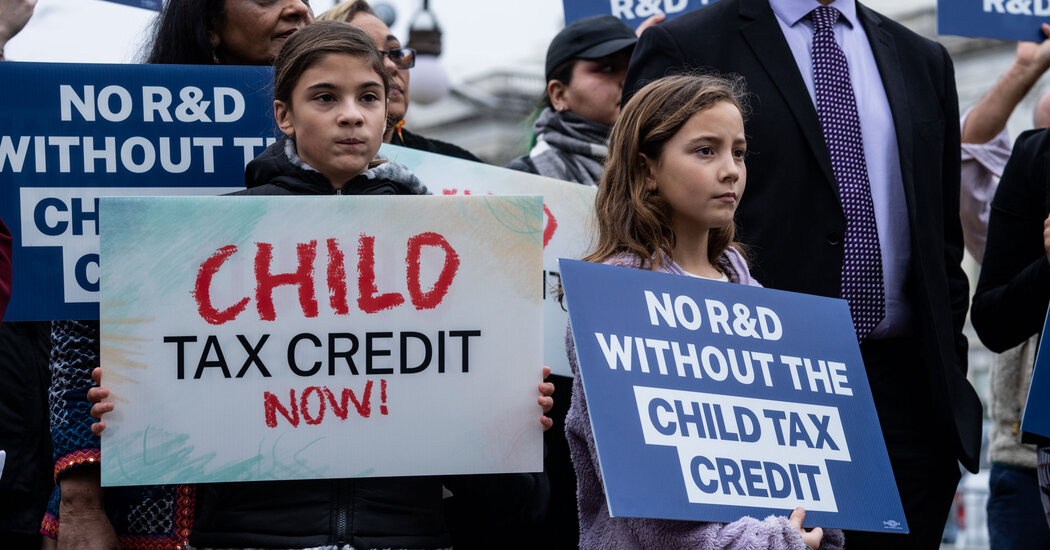
A bipartisan tax bill aimed at expanding the child tax credit and reinstating business tax breaks has hit a roadblock in the Senate after receiving broad approval in the House. Senate Republicans have raised concerns about the bill's generosity towards low-income families and its funding mechanism, stalling its progress as the filing deadline approaches. The $78 billion package, negotiated by top congressional tax writers, faces challenges in an election year, with Democrats hoping for a legislative win while Republicans may prefer to avoid it.

The US House passed a $79 billion tax cut package with bipartisan support, enhancing the child tax credit for lower-income families and boosting tax breaks for businesses. The bill faces uncertainty in the Senate, but represents a rare breakthrough for the House. Republicans seek to address the $10,000 cap on property tax deductions, while Democrats focus on boosting the child tax credit. The bill also enhances a tax credit for rental housing and provides relief for victims of natural disasters and the East Palestine, Ohio, train derailment.
The House passed a $79 billion tax cut package with broad bipartisan support, enhancing the child tax credit for lower-income families and boosting tax breaks for businesses. The bill faces uncertain prospects in the Senate, but represents a rare breakthrough for the House. Republicans seek to address the $10,000 cap on property tax deductions, while Democrats focus on boosting the child tax credit. Despite some criticism from both sides, a significant majority from each party voted for the bill, hoping to spur action in the Senate.
Senior lawmakers in Congress have reached a $78 billion bipartisan tax deal to expand the child tax credit and provide tax breaks for businesses. The agreement aims to enhance refundable child tax credits to benefit low-income families and lift the $1,600 refundable cap, potentially lifting 400,000 children above the poverty line in the first year. Democrats sought a larger child tax credit after an earlier version expired, causing child poverty to rise again. The deal also revives some expired portions of the 2017 Trump tax cuts for businesses, including expensing for research and experimental costs, an earlier interest deduction, small-business expensing expansion, and bonus depreciation extension. The goal is to pass the deal before the beginning of tax filing season, but Congress faces other priorities, such as averting a government shutdown and completing its funding process.
Top Democrats and Republicans in Congress have reached a $78 billion compromise to expand the child tax credit and reinstate three expired business tax breaks, but the package faces challenges in an election year. The plan includes extensions for the child tax credit and business tax benefits through 2025, as well as tax relief for disaster victims and Taiwanese workers and companies operating in the United States. The deal, brokered by Representative Jason Smith and Senator Ron Wyden, aims to be enacted in time for the start of tax filing season this month.