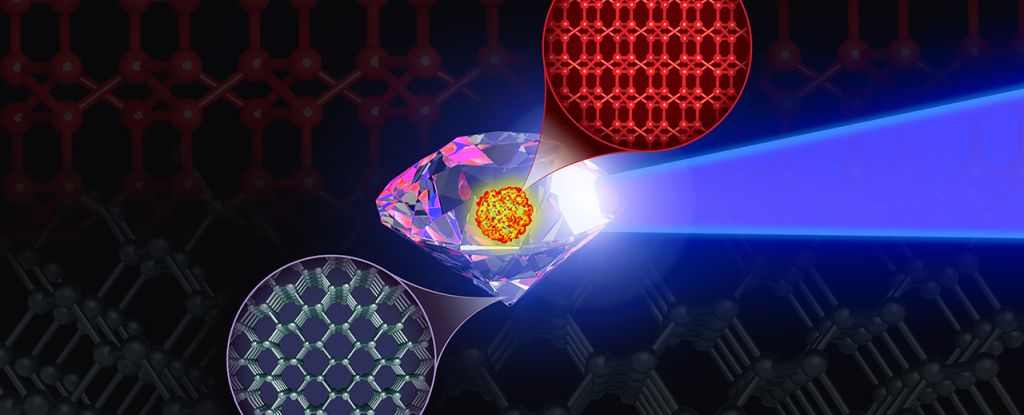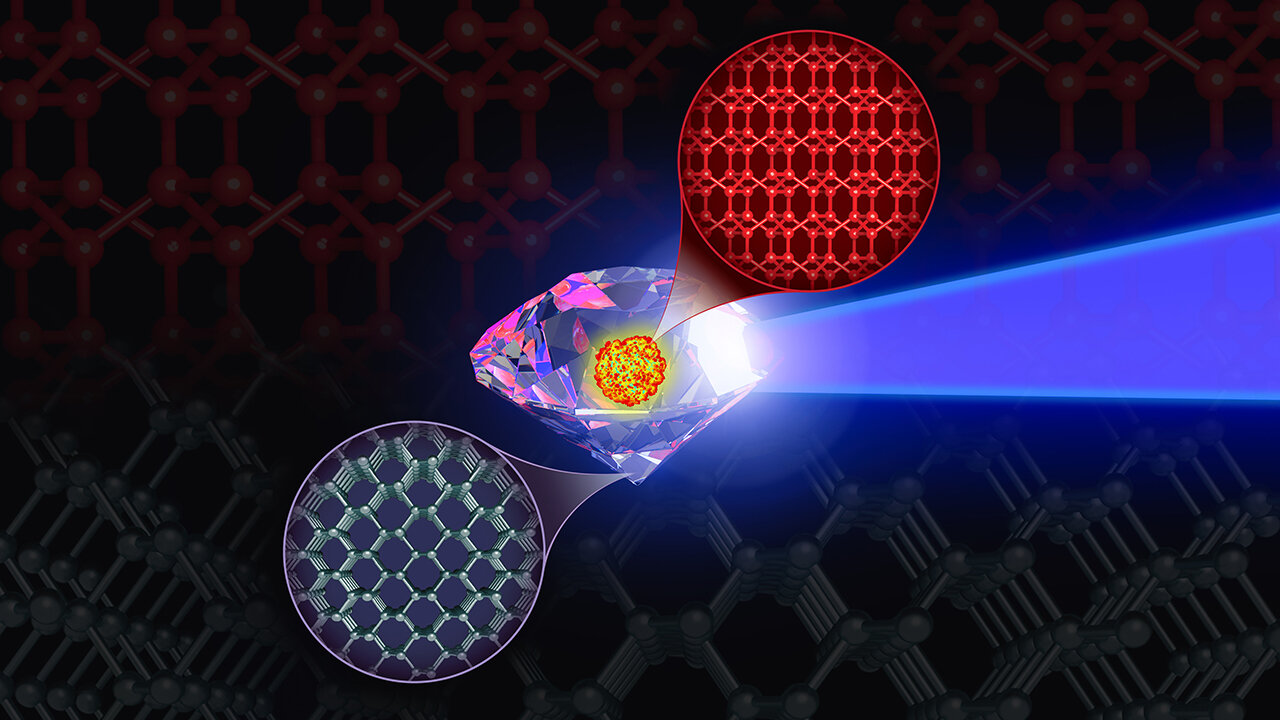
Physicists have used quantum-accurate molecular-dynamics simulations to discover a way to transform diamonds into an even harder material, known as the eight-atom body-centred cubic (BC8) phase, which is 30% more resistant to compression than diamonds. This unusual structure has only been observed in silicon and germanium on Earth, but it is believed to exist in highly-pressurized environments inside exoplanets. However, attempts to synthesize the BC8 phase have been unsuccessful due to the narrow high-pressure, high-temperature conditions required for its formation.

Physicists have used quantum-accurate molecular-dynamics simulations to discover a way to transform diamonds into an even harder material, known as the eight-atom body-centred cubic (BC8) phase, which is 30% more resistant to compression than diamonds. This unusual structure has only been observed in silicon and germanium on Earth, but it is believed to exist in the highly-pressurized environments inside exoplanets. However, attempts to synthesize it have been unsuccessful due to the narrow high-pressure, high-temperature conditions required.
Physicists have used quantum-accurate molecular-dynamics simulations to discover a way to transform diamonds into an even harder material, known as the eight-atom body-centred cubic (BC8) phase, which is 30% more resistant to compression than diamonds. This unusual structure has only been observed in silicon and germanium on Earth, but it is believed to exist in highly-pressurized environments inside exoplanets. However, attempts to synthesize it have been unsuccessful due to the narrow high-pressure, high-temperature conditions required.
Physicists have used simulations to discover a way to compress diamonds into an even harder material, known as the eight-atom body-centred cubic (BC8) phase, which is 30% more resistant to compression than diamonds. This structure, observed in silicon and germanium, has potential applications in highly-pressurized environments, such as inside exoplanets. However, synthesizing the BC8 phase has proven challenging due to the narrow range of temperature and pressure under which it can occur.
Physicists from the US and Sweden have simulated a way to transform diamonds into an even harder material, known as the eight-atom body-centred cubic (BC8) phase, which is believed to be 30% more resistant to compression than diamonds. This unusual structure has only been observed in silicon and germanium on Earth, but it is theorized to exist in highly-pressurized environments inside exoplanets. However, attempts to synthesize this material have been unsuccessful due to the narrow range of temperature and pressure under which the BC8 phase can occur.
Physicists have used quantum-accurate molecular-dynamics simulations to discover a way to transform diamonds into an even harder material, known as the eight-atom body-centred cubic (BC8) phase, which is 30% more resistant to compression than diamonds. This unusual structure has only been observed in silicon and germanium on Earth, but it is believed to exist in the highly-pressurized environments inside exoplanets. However, attempts to synthesize this material have been unsuccessful due to the narrow high-pressure, high-temperature conditions required for its formation.

Physicists have used supercomputing to simulate the behavior of diamond under high pressure and temperature, revealing new insights into the elusive BC8 phase of carbon, which is expected to be even harder than diamond. The simulations provide clues on the conditions needed to push carbon atoms into this unusual structure, potentially paving the way for its synthesis in a lab. The BC8 phase, thought to exist in high-pressure environments deep inside exoplanets, could open up new research and material application possibilities if stabilized closer to home. Despite previous difficulties in synthesizing BC8 carbon, the simulations have identified the specific high-pressure, high-temperature conditions required for its formation, offering hope for its eventual achievement.
Supercomputer simulations have predicted the existence of a new form of carbon, the BC8 phase, which is believed to be even tougher than diamond. This phase is thought to exist in the center of carbon-rich exoplanets and could potentially be synthesized on Earth. The simulations have revealed the extreme metastability of diamond at very high pressures and suggest viable compression pathways to access the BC8 phase. Researchers are now working on experimental methods to create this elusive super-diamond in the laboratory.