
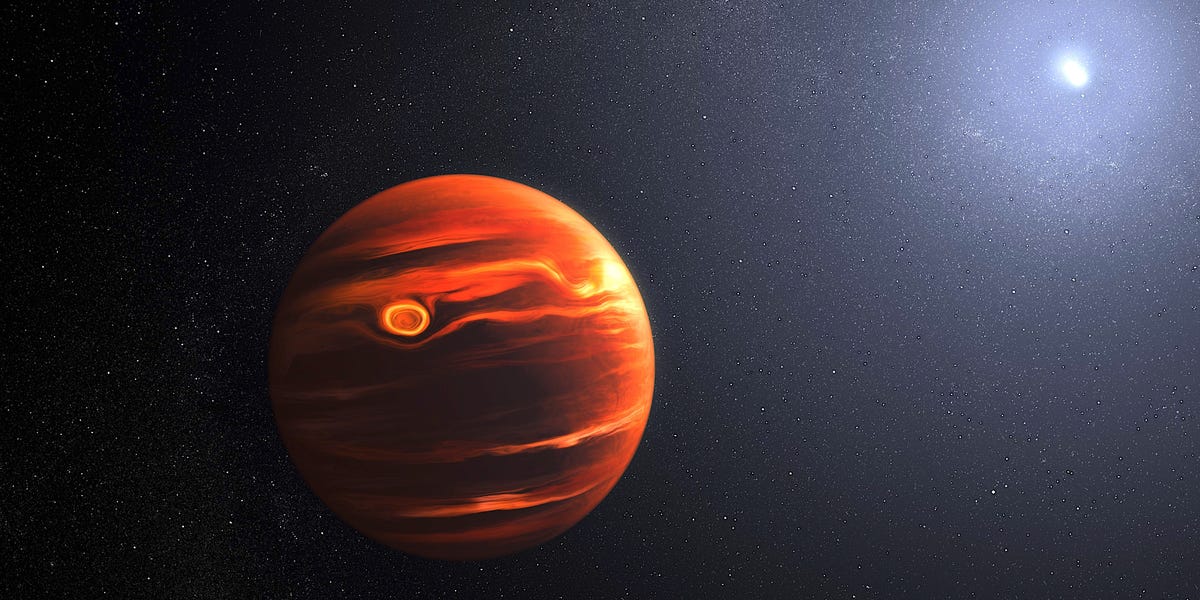
NASA's Webb Telescope detects sand storms and turbulent clouds on distant exoplanet.
NASA's James Webb Space Telescope has discovered sand storms on a "super Jupiter" planet called VHS 1256b, which is 235 trillion miles away from Earth. The clouds on the planet are made up of scorching hot, tiny sand-like particles known as silicates. Webb's ability to analyze the entire infrared spectrum of starlight passing through the planet's atmosphere has allowed astronomers to identify the largest number of molecules ever identified all at once on a planet outside our solar system, including water, methane, carbon monoxide, and carbon dioxide. The planet is a "super Jupiter" that's 12 to 18 times the size of our solar system's Jupiter and orbits two stars over a period of about 10,000 years.