
LIGO's Quantum Breakthrough: Probing More of the Universe
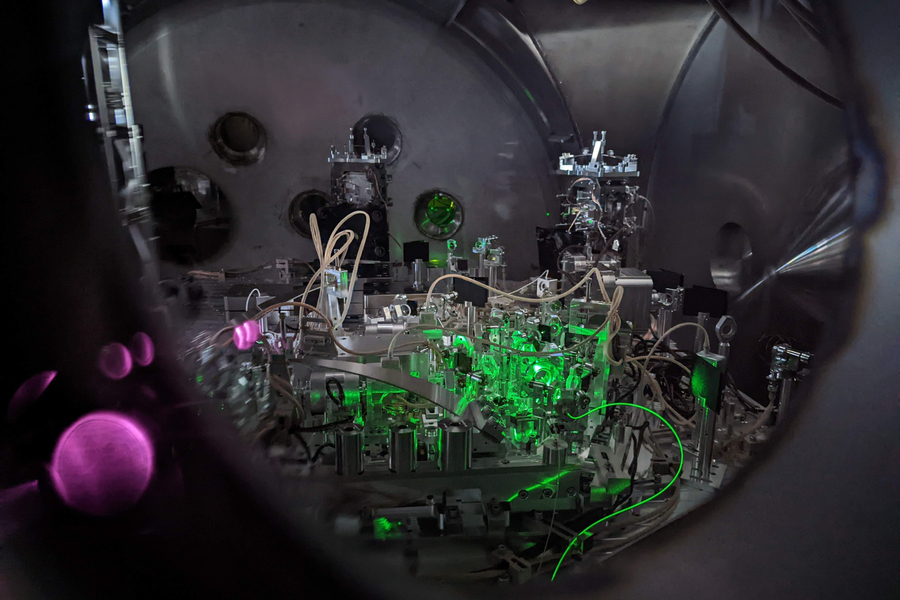
The Laser Interferometer Gravitational-Wave Observatory (LIGO) has achieved a significant breakthrough by surpassing the standard quantum limit for signals in its detectors. LIGO uses interferometry to detect gravitational waves, and by optimizing the trade-off between amplitude and phase uncertainty through the technique of squeezed quantum states, the detection sensitivity of LIGO has improved by up to 65%. This advancement allows for the detection of mergers at greater distances and the characterization of fainter-amplitude signals. The frequency-dependent quantum squeezing technique will be implemented in LIGO's fourth observing run, along with the upgraded Virgo detector and the KAGRA gravitational wave observatory, providing a clearer window into the gravitational wave Universe.
- LIGO squeezes quantum states past the quantum limit Big Think
- World's largest gravitational wave observatory squeezes light beyond the 'quantum limit' Livescience.com
- LIGO Has Surpassed The Quantum Limit. We Can Explain. ScienceAlert
- Gravitational Wave Observatory Reaches Beyond The Quantum Limit IFLScience
- New tubes enable LIGO to probe 60% more of the universe Interesting Engineering
- View Full Coverage on Google News
Reading Insights
0
1
13 min
vs 14 min read
96%
2,695 → 108 words
Want the full story? Read the original article
Read on Big Think