
JWST Spots MoM-z14, the Universe’s Oldest Galaxy Yet (280 Million Years After the Big Bang)
TL;DR Summary
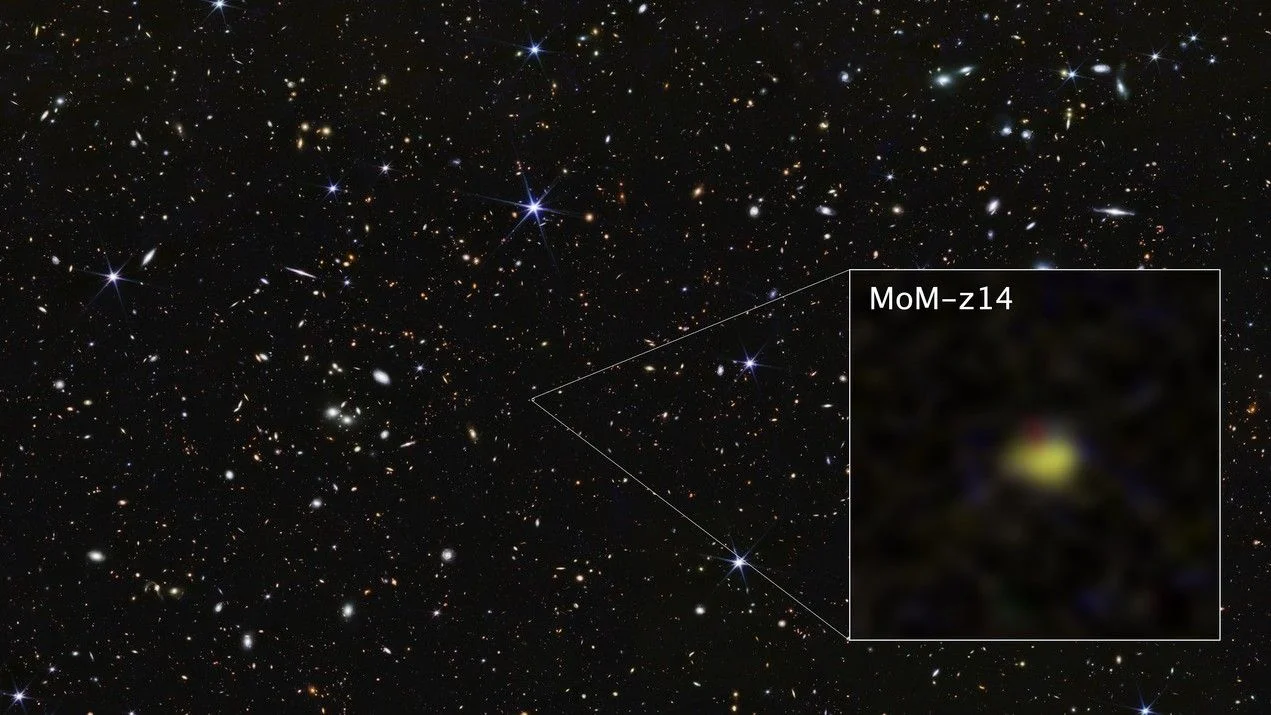
NASA’s James Webb Space Telescope confirmed MoM-z14 as the most distant spectroscopically confirmed galaxy to date, seen as it emitted light about 280 million years after the Big Bang (redshift z=14.44). The galaxy is compact (roughly 240 light-years across) with a mass similar to the Small Magellanic Cloud, and shows rapid star formation and nitrogen-rich composition, suggesting early, globular-cluster–like stellar activity. The finding, first reported in a 2025 preprint and later peer‑reviewed in early 2026, challenges existing models of early galaxy formation and signals more discoveries to come, including with the Nancy Grace Roman Space Telescope.
- James Webb telescope discovers closest galaxy to the Big Bang ever seen Live Science
- NASA Webb Pushes Boundaries of Observable Universe Closer to Big Bang NASA Science (.gov)
- Webb reveals five-galaxy merger just 800 million years after the Big Bang Phys.org
- Astronomers share new insights about the early universe via the Webb Space Telescope Engadget
- Webb has done it again. New-found galaxy at the dawn of time is challenging what we know about the Universe BBC Sky at Night Magazine
Reading Insights
Total Reads
1
Unique Readers
14
Time Saved
55 min
vs 56 min read
Condensed
99%
11,174 → 96 words
Want the full story? Read the original article
Read on Live Science