
The Mystery of Black Stains on Leonardo da Vinci's Codex Atlanticus Solved.
TL;DR Summary
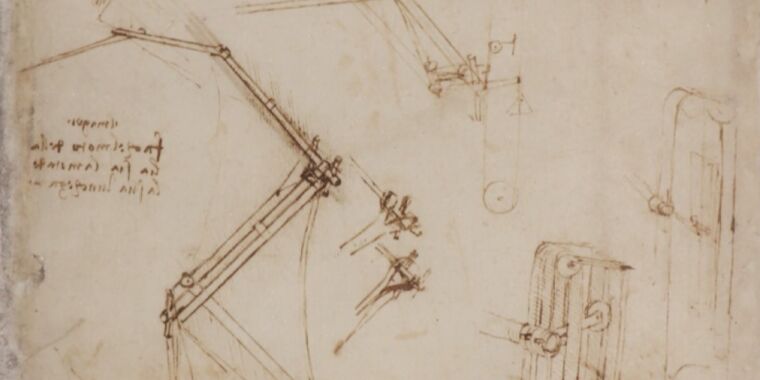
Researchers at the Politecnico di Milan in Italy have identified the cause of mysterious black stains on a folio of Leonardo da Vinci's Codex Atlanticus as starch and vinyl glues applied during an earlier restoration effort some 50 years ago. They also found nanoparticles of a mercury sulphide called metacinnabar in the protective paper holding the folio, although it is unclear how this unusual black crystalline phase might have formed. In 2020, scientists analyzed the microbes found on seven of da Vinci's drawings and found that each drawing had its own unique microbiome, dominated by bacteria rather than fungi, contradicting widespread belief.
Topics:science#codex-atlanticus#leonardo-da-vinci#microbes#nanopore-sequencing#restoration#science-and-technology
Reading Insights
Total Reads
0
Unique Readers
13
Time Saved
3 min
vs 4 min read
Condensed
83%
604 → 102 words
Want the full story? Read the original article
Read on Ars Technica