
"Slow Genome Evolution in Frogs Revealed by Conserved Chromatin and Repetitive Patterns"
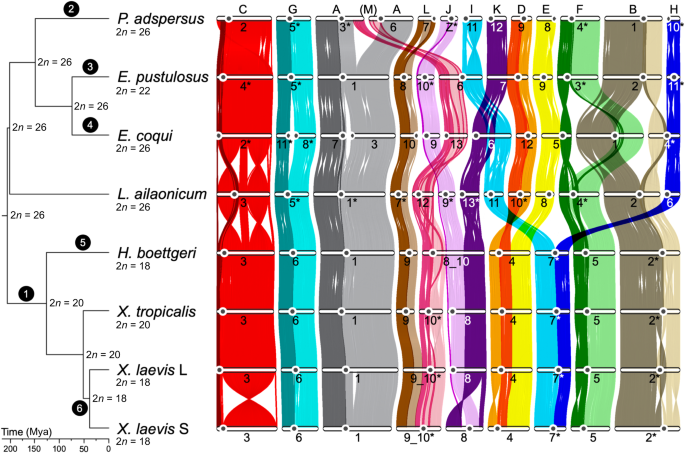
A study reports a high-quality reference genome sequence for the western clawed frog, Xenopus tropicalis, along with draft chromosome-scale sequences of three distantly related emerging model frog species, revealing that frog chromosomes have remained remarkably stable since the Mesozoic Era with limited translocations and fusions. The study explores the structure of chromosomes across frogs, using a dense meiotic linkage map for X. tropicalis and chromatin conformation capture (Hi-C) data for all species, revealing conserved ancestral anuran chromosomes from which contemporary frog genomes were constructed. The findings provide essential resources for further work to exploit the experimental possibilities of these diverse animals and make anurans ripe for comparative genomic and evolutionary analysis.