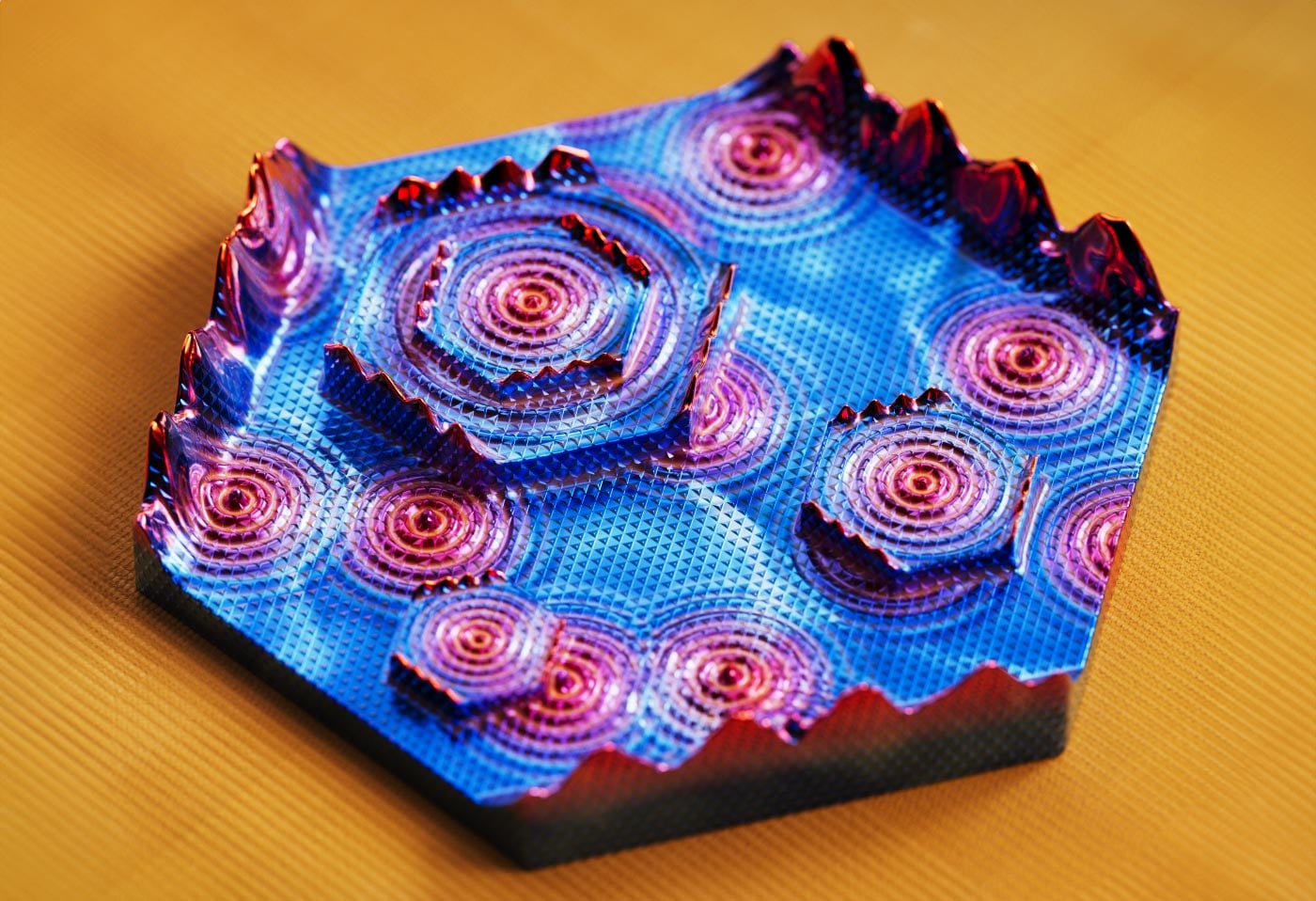
MIT researchers developed a framework to evaluate the commercial potential of quantum materials by considering their quantum properties, cost, and environmental impact, identifying promising sustainable materials for future applications in electronics, energy, and medicine.
Physicists at Princeton University have discovered a new quantum state, "hybrid topology," in arsenic crystals, merging edge and surface states in a unique quantum behavior. This groundbreaking finding, published in Nature, has significant implications for developing new quantum devices and technologies. The discovery opens up possibilities for engineering new topological electron transport channels and designing future nanodevices and spin-based electronics. The observation of the combined topological edge mode and the surface state may enable the development of quantum information science and quantum computing devices. This finding also paves the way for potential applications in quantum technologies and "green" technologies.
Physicists have successfully isolated "massless" Dirac electrons, revealing their weightless nature and unprecedented velocity, while also uncovering their significant role in topological materials. This achievement required creating extreme conditions and specific spin manipulation. The study broadens our understanding of quantum behavior and opens new doors for the development of cutting-edge electronic devices and materials, marking a monumental leap forward in harnessing the potential of quantum physics for real-world applications.
Researchers at Tel Aviv University have conducted a study using a large mechanical system of coupled pendula to visualize phenomena occurring in specialized "topological" materials, which are difficult to observe directly in quantum systems. The system mimics the dynamics of quantum systems and allows for the direct measurement of three phenomena: Bloch oscillations, Zener tunneling, and wave evolution in a topological medium. The experiment provides insights into the behaviors of electrons in periodic systems and opens the door to further exploration of complex quantum effects in a controlled manner.