The S&P 500's PE ratio has just surpassed 30, a level historically associated with low future returns and increased risk of a market correction, indicating that stocks are currently very expensive and potentially due for a downturn.
The stock market is approaching a P/E ratio of 30, a level historically associated with market downturns, amid deteriorating economic indicators like weak employment growth, sluggish GDP, rising inflation due to tariffs, and high valuations driven more by soaring prices than earnings. While a potential Fed rate cut offers some hope, the current high valuations and diverging earnings growth suggest caution for investors, as the market could face significant declines if fundamentals catch up with valuations.
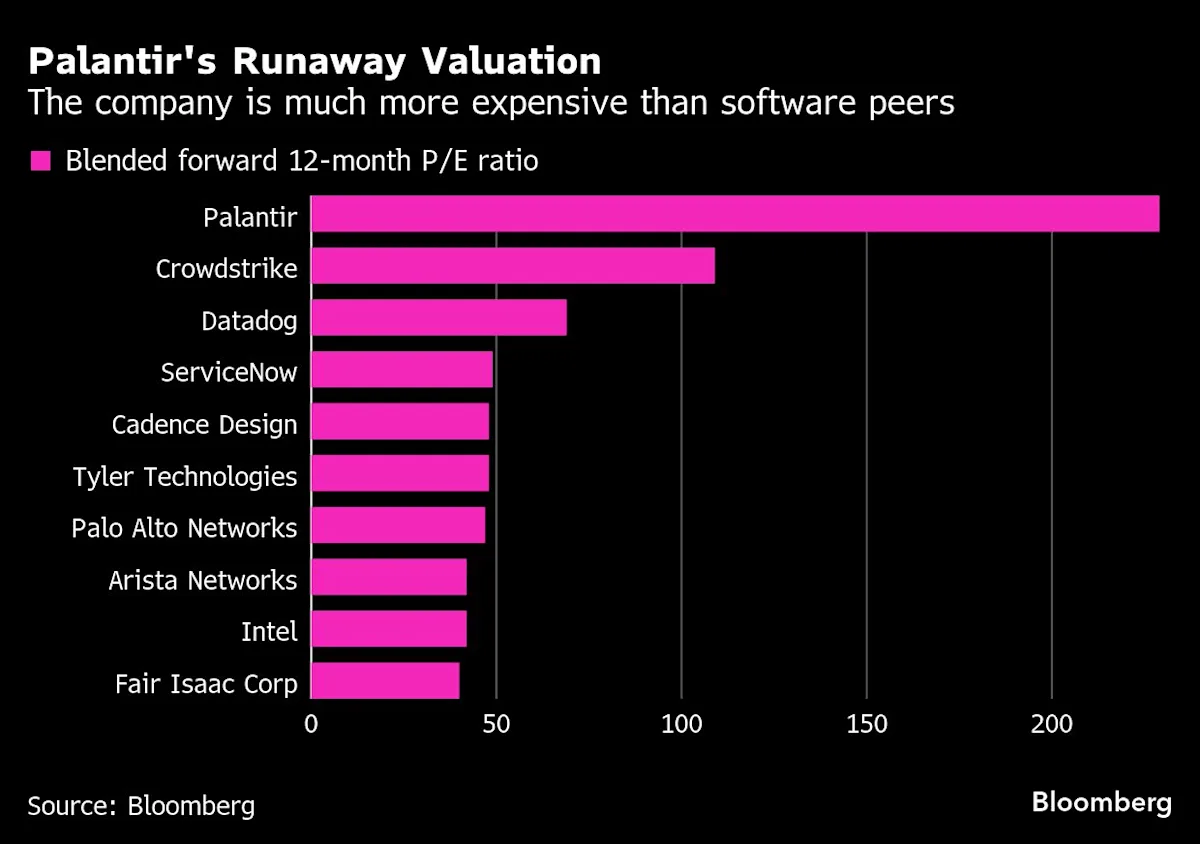
Palantir's stock, with the highest P/E ratio on the S&P 500, faces scrutiny as investors await strong earnings to justify its lofty valuation, driven by growth prospects in government and commercial sectors, especially AI, amid concerns over its high valuation and competitive talent market.
Palantir's stock, with the highest P/E ratio on the S&P 500, continues to attract investor interest despite concerns over its high valuation. The company is expected to report strong earnings driven by growth in government and commercial sectors, especially in AI. Analysts acknowledge the company's momentum and potential, but also warn that Palantir must deliver exceptional results to justify its lofty valuation, with some comparing its potential to an 'Apple moment' if it can sustain rapid growth.
Despite historical expectations of mean reversion, profit margins for S&P 500 companies have continued to rise over the past 30 years, challenging traditional theories. The possibility of profit margins continuing to rise at the same rate is debated, with some attributing it to the impact of AI on productivity growth. However, skepticism is advised, as past "new era" narratives have led to market bubbles. The stock market's future hinges on profit margin expansion, sales growth, and P/E ratio, with sobering implications if profit margins remain constant or decline.