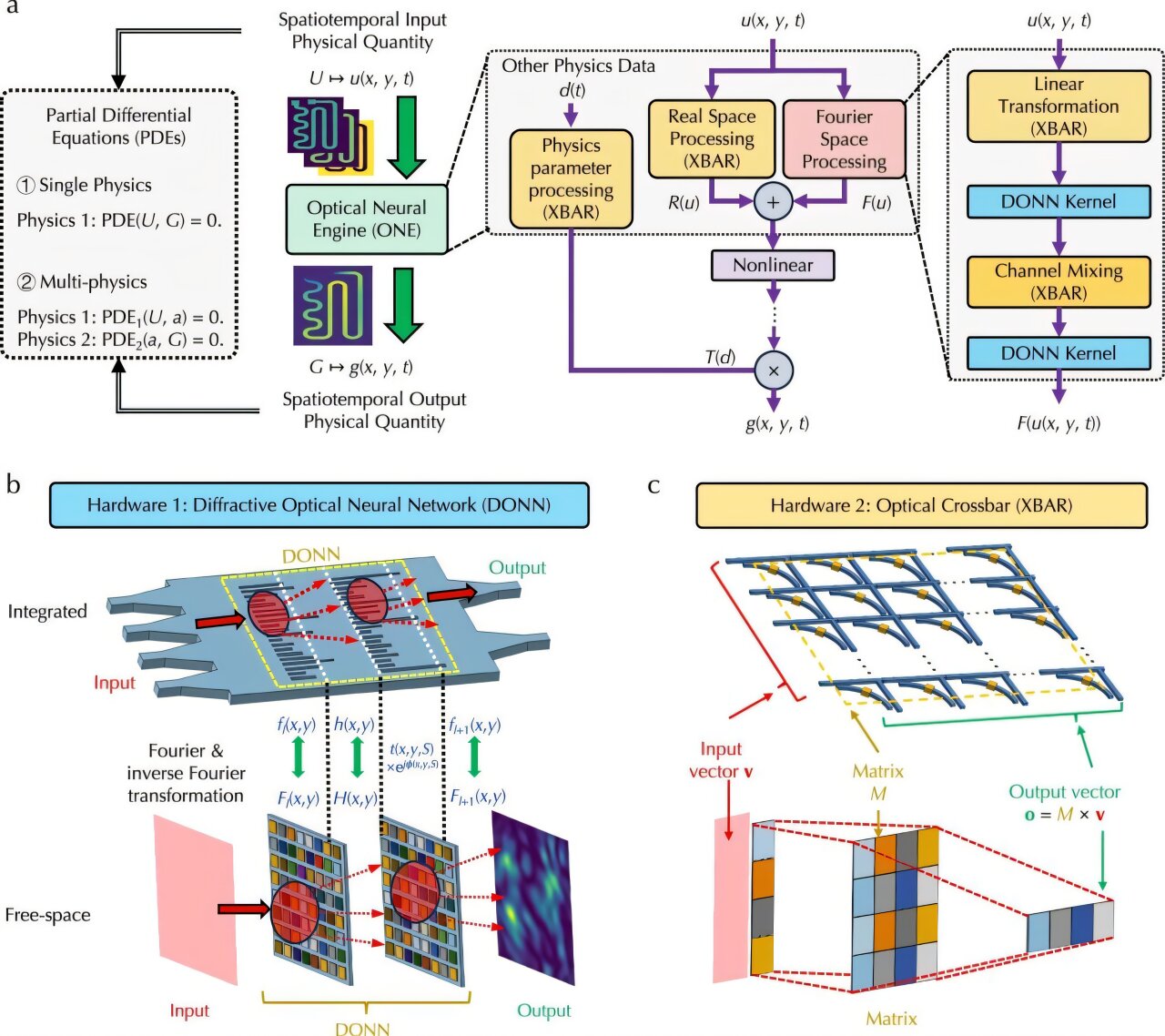
Researchers at the University of Utah have developed an 'optical neural engine' (ONE) that uses light to solve complex partial differential equations more quickly and efficiently than traditional electronic methods, with potential applications in physics, geology, and engineering.
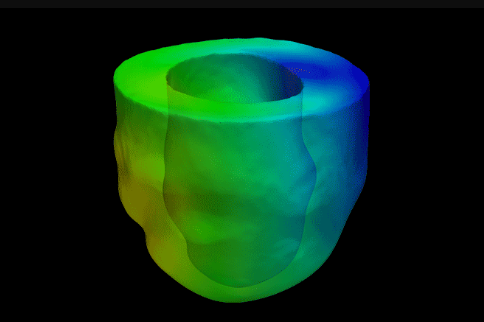
A new AI framework called DIMON, developed by researchers at Johns Hopkins University, can solve complex engineering problems involving partial differential equations much faster than traditional supercomputers. This technology allows personal computers to efficiently model scenarios like car crashes or heart arrhythmias by predicting solutions without recalculating for each new shape. DIMON's ability to rapidly solve these equations could significantly impact various engineering fields, making processes like cardiac diagnostics faster and more accessible.
Researchers at Johns Hopkins University have developed a new AI framework called DIMON that can solve complex engineering problems, such as modeling car crashes or predicting heart arrhythmias, much faster than traditional methods. This AI can handle partial differential equations across various shapes without recalculating grids, significantly speeding up simulations and optimizing designs. The technology promises to revolutionize fields like engineering and medicine by enabling personal computers to perform tasks that typically require supercomputers.
Researchers have proposed a new method called "physics-enhanced deep surrogates" (PEDS) for developing data-driven surrogate models to efficiently solve complex physical systems governed by partial differential equations (PDEs) in fields such as mechanics, optics, thermal transport, fluid dynamics, physical chemistry, and climate models. This method combines a low-fidelity physics simulator with a neural network generator, resulting in surrogates that are up to three times more accurate than traditional neural networks and require significantly less training data. The technique offers accuracy, speed, data efficiency, and physical insights into the process, making it a promising tool for a wide range of applications in engineering and beyond.
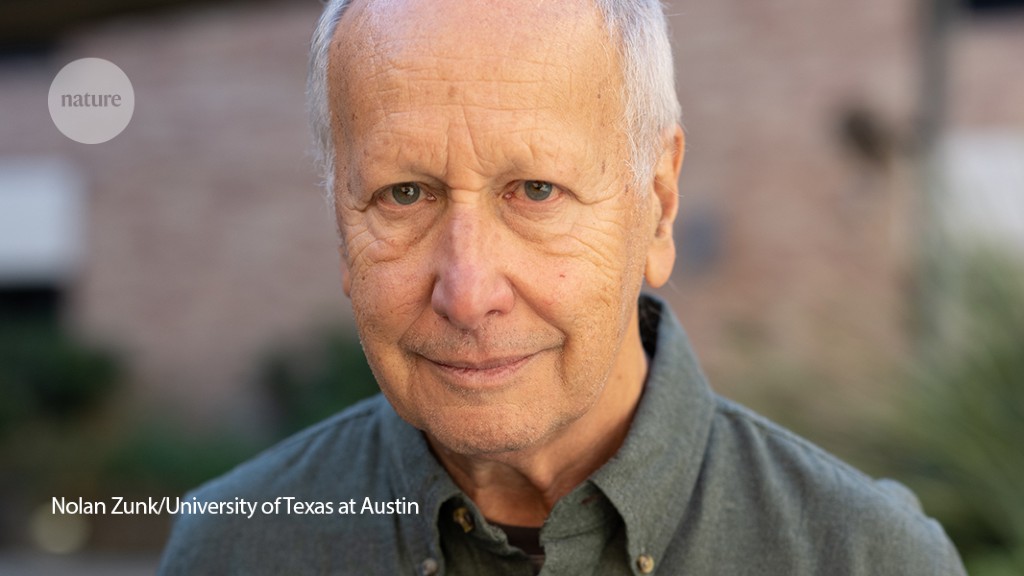
Argentinian mathematician Luis Caffarelli has won the 2023 Abel Prize for his work on equations that are important for describing physical phenomena, such as how ice melts and fluids flow. Caffarelli is the first person born in South America to win the award. Many of Caffarelli’s most celebrated results have to do with the regularity of the solutions of so-called partial differential equations, which are among the most important equations in maths and physics.
Luis Caffarelli, a professor of mathematics at the University of Texas at Austin, has been awarded the Abel Prize, the equivalent of the Nobel Prize for mathematics, for his work on partial differential equations. Caffarelli's research has contributed significantly to the understanding of free boundary problems, including the melting of ice, and the Navier-Stokes equations, which describe the dynamics of incompressible fluids. His work has also found applications in the financial world. The Abel Prize is awarded annually to highlight important advances in mathematics.