
Tag

Nuclear Batteries

All articles tagged with #nuclear batteries

science-and-technology4 months ago

NASA Develops Long-Lasting Nuclear Batteries for Centuries-Long Space Missions

NASA is researching americium-241 as a new isotope for nuclear batteries to power spacecraft for centuries, potentially enabling longer and more distant space missions beyond current capabilities that rely on plutonium-238. This development involves testing advanced conversion systems like Stirling engines to harness the isotope's long half-life, promising a new era of sustainable deep space exploration.

science-and-technology1 year ago

NASA's Voyager Probes Face Imminent Shutdown as Power Fades

NASA's Voyager 1 and Voyager 2 probes, launched in 1977, are nearing the end of their missions as their nuclear batteries deplete. These batteries, which convert heat from decaying Plutonium-238 into energy, are running low, prompting NASA to gradually shut down systems to conserve power. Despite communication challenges, both probes continue to send data from beyond the heliosphere, with hopes they will last until their 50th anniversary in 2027. Once power is exhausted, the probes will drift indefinitely through space.

space-technology2 years ago

"Revolutionary Radioisotope Thermoelectric Generator Lightens Interplanetary Missions"

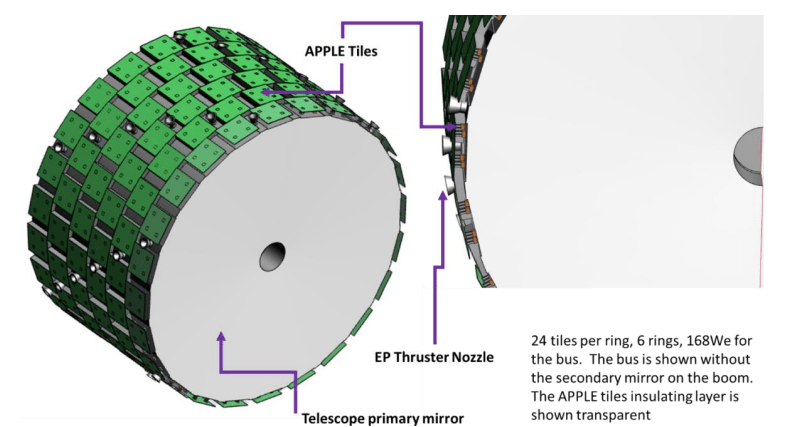
Engineers from the Aerospace Corporation and Oak Ridge National Lab have developed a concept called the Atomic Planar Power for Lightweight Exploration (APPLE) project, which aims to significantly reduce the weight of interplanetary missions by shrinking the size of radioisotope thermoelectric generators (RTGs). The APPLE project utilizes a tile-based design that combines power generation and storage, allowing for flexible power output and battery support. The tiles can be strung together to meet the specific power requirements of different spacecraft. The project uses Plutonium-238 as the isotope and incorporates radiation shielding considerations. While the technical development status and funding of the project are unclear, it presents an ingenious solution for smaller interplanetary missions.