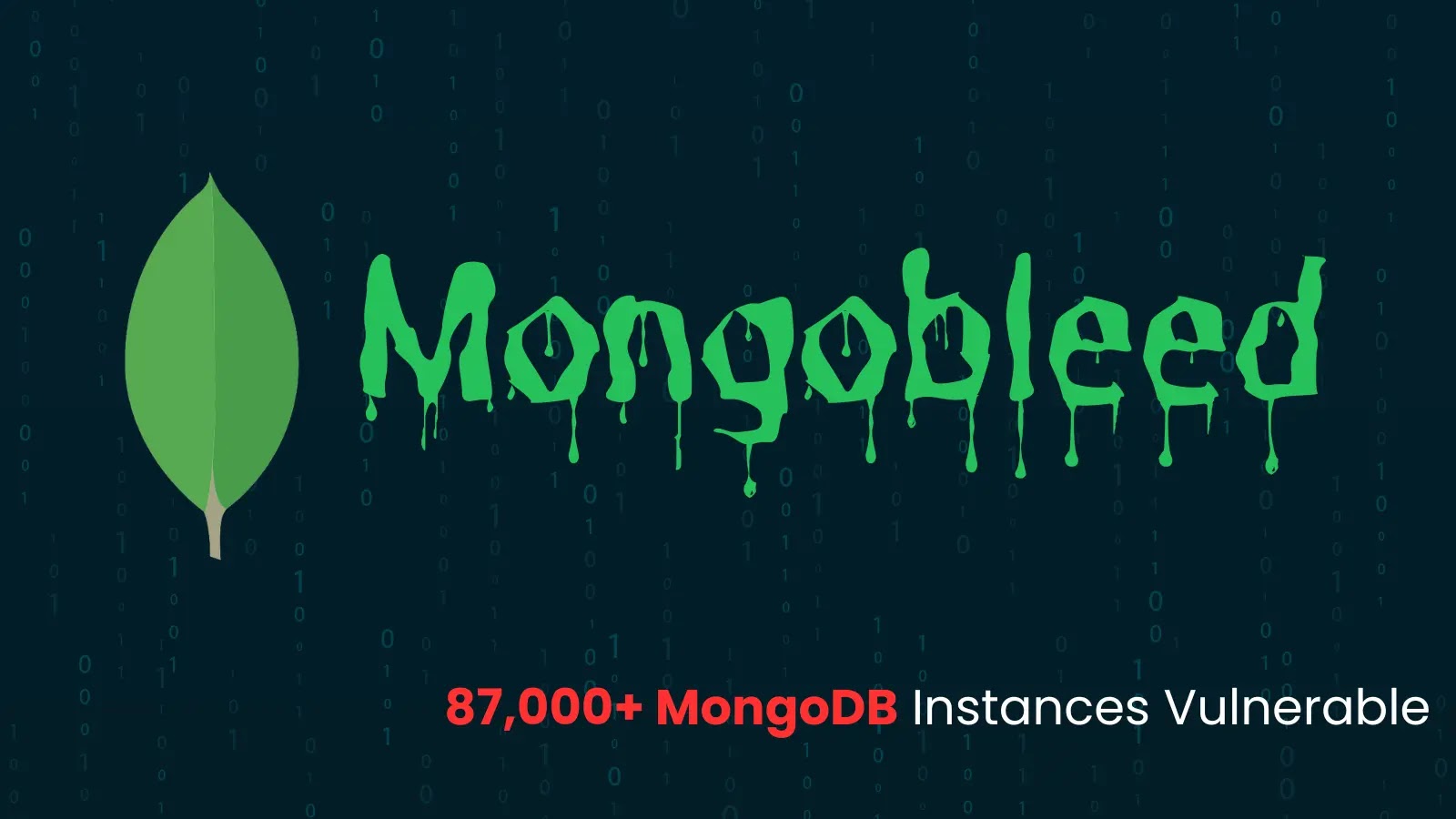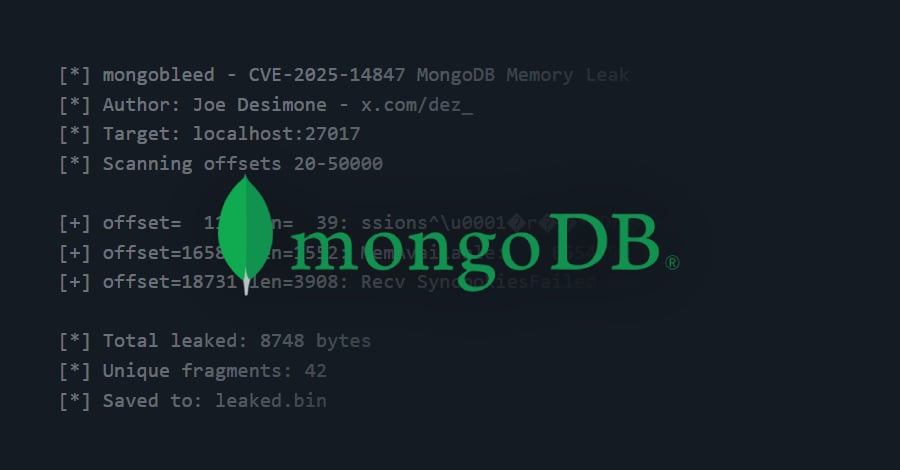
A critical vulnerability in MongoDB, CVE-2025-14847, allows unauthenticated attackers to remotely leak sensitive data by exploiting a flaw in zlib compression, with over 87,000 instances potentially affected worldwide. Users are advised to update their MongoDB versions and implement mitigations such as disabling zlib compression and restricting server exposure.

A critical security flaw called MongoBleed (CVE-2025-14847) in MongoDB servers is actively exploited in the wild, allowing attackers to leak sensitive data through malformed network packets before authentication, affecting many versions and exposing approximately 87,000 vulnerable instances worldwide. Immediate patching and monitoring are recommended.
A critical vulnerability named MongoBleed (CVE-2025-14847) affects over 87,000 MongoDB instances by allowing unauthenticated remote attackers to extract sensitive data through uninitialized memory disclosure in zlib decompression. The flaw impacts multiple versions, with patches available, and a PoC exploit has been released, increasing the risk of active exploitation. Administrators are urged to update their systems or apply temporary mitigations such as disabling zlib compression and restricting network access.
A PoC exploit called 'mongobleed' has been released for a critical MongoDB vulnerability (CVE-2025-14847) that allows attackers to remotely extract sensitive uninitialized memory data through a flaw in zlib decompression handling, prompting urgent patching and security measures.
A critical security vulnerability in MongoDB (CVE-2025-14847) allows unauthenticated attackers to read uninitialized heap memory, potentially exposing sensitive data. The flaw affects multiple versions and has been patched in newer releases; users are advised to upgrade or disable zlib compression to mitigate risks.
MongoDB has issued an urgent warning to patch a severe remote code execution vulnerability (CVE-2025-14847) affecting multiple versions of its database software. The flaw, due to improper handling of length parameters, allows unauthenticated attackers to execute arbitrary code. Admins are advised to upgrade to patched versions immediately or disable zlib compression to mitigate the risk. The vulnerability has been actively exploited in the past, emphasizing the need for prompt action.
Top Wall Street analysts favor Nvidia, MongoDB, and CrowdStrike for their strong growth prospects driven by technological advancements and AI adoption, with positive ratings and price targets based on in-depth research.
MongoDB's stock surged after reporting strong Q2 earnings, with revenue and subscription growth driven by AI application demand, despite previous struggles and industry concerns about AI's impact on software business models.
MongoDB's shares rose 13% after the company reported better-than-expected Q1 earnings, raised its guidance, and increased its share buyback program, indicating strong financial performance.
MongoDB reported strong Q1 2025 results with revenue of $549 million, beating estimates, and a significant increase in operating income and customer base, leading to a 14.3% stock jump. The company raised its full-year revenue guidance and shows impressive long-term growth, positioning itself as a key player in enterprise software and AI-driven solutions.
MongoDB, Inc. has surpassed Q3 estimates, highlighting its AI investments and long-term growth potential. Sundar Pichai, speaking at the DealBook summit, suggested that AI advancements will slow down as the industry faces steeper challenges, with significant breakthroughs needed for further progress. Meanwhile, OpenAI has launched its 12 Days of OpenAI, introducing new products and features, including the o1 reasoning model, which emphasizes a 'chain of thought' technique. This model, while promising, raises concerns about AI risks, as noted in a safety review by Apollo Research.
MongoDB's stock fell sharply despite exceeding third-quarter earnings expectations due to the announcement of CFO and COO Michael Gordon's departure. While the company reported a 22% increase in sales and higher-than-expected earnings, the unexpected management change overshadowed these strong results, causing investor concern. The stock's decline also reflects broader market dynamics, as MongoDB's valuation had been high compared to competitors like Oracle. This drop may present a buying opportunity for investors.
MongoDB reported strong fiscal third-quarter earnings, with adjusted earnings of $1.16 per share on $529.4 million in revenue, surpassing analyst expectations. Despite this, the stock fell over 7% due to a recent rally and the announcement of CFO Michael Gordon's departure. Analysts noted the revenue beat was driven by Enterprise Advanced deals rather than the Atlas cloud offering. MongoDB's stock had recently surged following positive industry trends, but the CFO transition and revenue composition raised investor concerns.
Last week saw significant declines in several large-cap stocks, with MongoDB, Nutanix, DraftKings, Salesforce, and Celsius Holdings among the biggest losers. MongoDB shares fell 31.63% due to weak guidance, while Salesforce dropped 13.94% after issuing weak Q2 guidance. Other notable declines included Nutanix, DraftKings, and Celsius Holdings, driven by various factors such as earnings results and tax hikes.
MongoDB's stock dropped by 25.1% after reporting slower-than-expected growth and disappointing guidance for the second quarter. Despite a 22% increase in overall revenue, the company's growth rate has slowed, and it remains unprofitable on a GAAP basis. The company's forecasts for the rest of the year also fell short of estimates, leading to investor concerns.