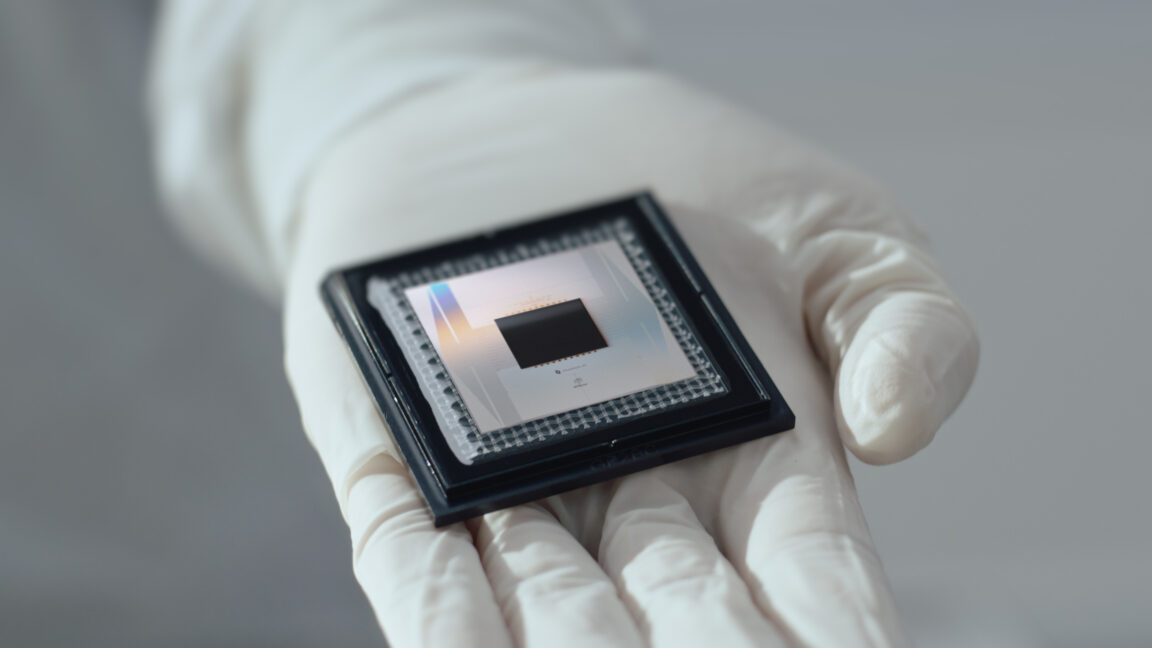
Google's quantum computing team has achieved a significant milestone by stabilizing an error-corrected quantum bit for an hour using their new Willow chip, which features 105 qubits. This advancement demonstrates the potential of quantum error correction to support complex algorithms. Google has also invested in its own fabrication facility to enhance process control and reduce noise in its superconducting processors. The work highlights the exponential improvements in error correction as more hardware qubits are dedicated to a single logical qubit, paving the way for more reliable quantum computing.

Researchers have developed a new photonic approach to quantum computing that operates at room temperature and uses laser pulses to create inherently error-correcting logical qubits, simplifying quantum computing. This method, demonstrated by a team of researchers, shows promise in addressing the challenges of insufficient qubits and susceptibility to external influences, but further improvements in error tolerance are needed.
Scientists have made a breakthrough in quantum error correction by creating an error-free quantum bit, or qubit, from a single pulse of light, potentially paving the way for light-based room-temperature quantum computers in the future. This development could address the instability and failure issues associated with traditional qubits, which are typically made from superconducting metals and require near absolute zero temperatures for stability. The new approach involves creating a logical qubit from a single laser pulse containing multiple entangled photons, offering inherent error correction capabilities. While the experimental results are promising, further research is needed to achieve the error-correction levels required for practical use in quantum computing.