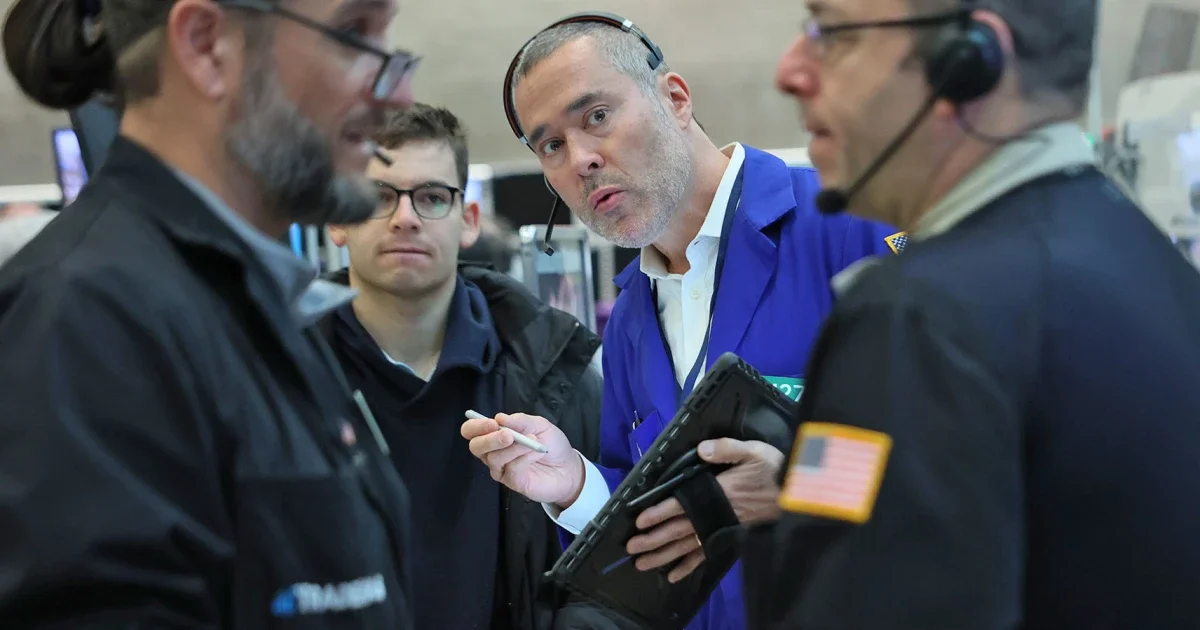
Markets swung on AI hype as investors question when AI spending will translate into profits; IBM, Visa and Mastercard led declines amid renewed volatility, while some software names benefited from AI updates, and analysts caution that underlying businesses haven’t dramatically changed despite advancing AI tools.
U.S. stocks rose with the Dow about 400 points higher and the S&P 500 up roughly 0.5% and the Nasdaq up about 0.7%, led by IBM and Salesforce in the Dow as AI fears ease. The S&P’s AMD gained traction after a Meta deal to buy GPUs for AI, while semiconductor and software ETFs jumped; but laggards like American Express and JPMorgan kept some risk in check, signaling cautious optimism after the AI-driven selloff.
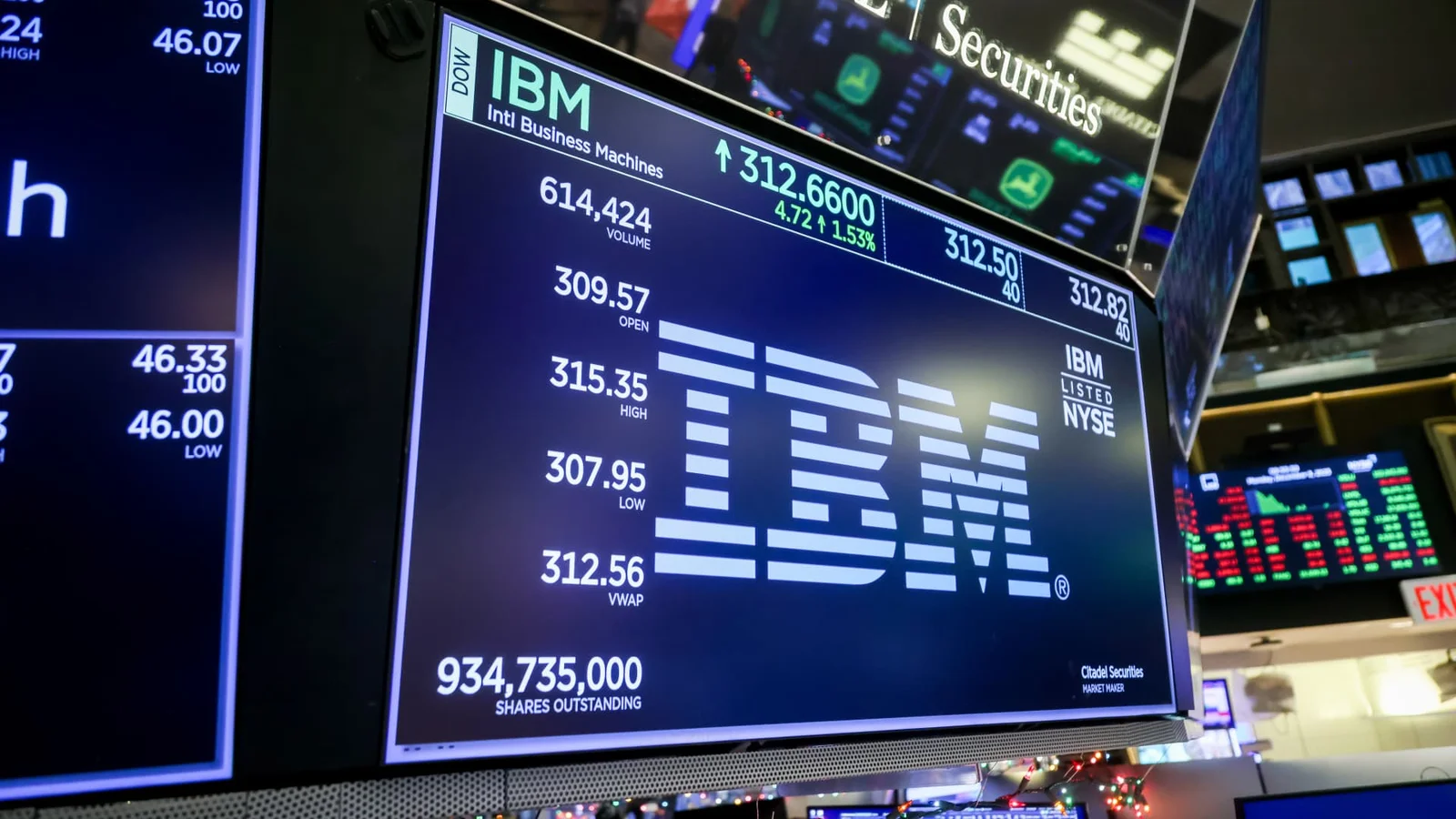
IBM shares fell 13.2%, the steepest one-day drop since October 18, 2000, after Anthropic said its Claude Code AI could automate COBOL modernization on IBM mainframes, fueling a broader sell-off in software stocks.
IBM shares fell about 13% in a session—the steepest one‑day drop since 2000—after Anthropic suggested AI could modernize COBOL, fueling concerns about IBM’s reliance on legacy technology and its growth prospects.
IQM Quantum Computers plans an $1.8B SPAC merger with Real Asset Acquisition Corp (RAAQ), aiming to list in the U.S. and Helsinki and raise over $450M; a Naples court halted IBM’s €61M Salerno quantum project on bid-process grounds, creating delay risk; Quantum eMotion is uplisting to the NYSE American to expand U.S. market access; Coinbase is forming an advisory board to assess post-quantum crypto risk and chart a path to upgrades; and quantum tools are beginning to influence game design by testing complex systems early, signaling broader industry adoption.
IBM shares slid roughly 10% after Anthropic unveiled Claude Code, an AI tool to automate COBOL modernization, with Accenture and Cognizant retreating on the news; Claude Code maps dependencies, documents workflows, and identifies risks to speed modernization of legacy COBOL systems that still power ATM networks and other critical infrastructure. Anthropic released a Code Modernization Playbook alongside the launch.
IBM stock fell about 13% after Anthropic said Claude Code could automate COBOL modernization, threatening IBM’s legacy mainframe business since COBOL underpins many critical systems (including the majority of U.S. ATM transactions); the AI disruption adds to market jitters and IBM has slumped more than 24% year-to-date.
IBM’s mainframe unit posted its best Q4 in over 20 years, with the z17 AI-accelerated system delivering real-time inferences (up to 450 billion per day, ~1 ms latency) and driving a 61% YoY revenue gain; IBM is also marketing Spyre accelerators and foresees enterprise AI workloads shifting toward private data centers or clouds, underpinning a forecast of at least 5% total revenue growth in 2026 and stronger free cash flow as mainframes remain a core pillar of its AI strategy.
IBM reported Q4 2025 revenue of $19.7B, up 12% year over year (9% at constant currency), led by software up 14% and infrastructure up 21%. Full-year 2025 revenue reached $67.5B, up 8% (6% CC). Gross margin (GAAP) was 60.6% in Q4 (61.8% non-GAAP); full-year GAAP 58.2% (59.5% non-GAAP). Free cash flow for 2025 was $14.7B; operating cash flow was $13.2B. IBM cites a generative AI book of business over $12.5B and projects full-year 2026 revenue growth of more than 5% in constant currency with about $1B higher free cash flow. The dividend was declared at $1.68 per share for the Feb 10, 2026 record date. The company also provided segment details showing strength across Software, Consulting and Infrastructure. }{
Top Evercore analyst Amit Daryanani turns constructive on several large-cap tech names ahead of earnings season, highlighting Apple, Alphabet, Microsoft, Tesla, and IBM as stocks that could stand out as cloud, software, and AI-driven growth supports results.
McKinsey projects the quantum computing market to grow from about $4B today to $72B by 2035. Rather than betting on risky startups, the piece argues that blue-chip giants Nvidia, IBM, and Alphabet offer lower-risk exposure to quantum growth: Nvidia bridges quantum and classical systems with NVQLink/CUDA-Q; IBM pursues scalable quantum roadmaps (Nighthawk) aiming for thousands of qubits by 2028; Alphabet’s Willow demonstrates faster, more accurate quantum results with substantial cash reserves to fund development. This trio provides a way to invest in quantum tech with established profitability and scale.
IBM's Institute for Business Value finds executives expect AI spending to shift from efficiency to innovation by 2030, with the winners embedding AI into every decision and operation. IBM’s 63-page study, released alongside Davos, also offers tips: tailor AI to fit core capabilities, enable rapid experimentation with adaptable models, and make AI fluency a leadership requirement as enterprises move toward an AI-driven future.
IBM and The All England Lawn Tennis Club have renewed their 36-year partnership, focusing on enhancing Wimbledon’s digital experiences through AI-powered solutions to increase global fan engagement and accessibility, with initiatives like personalized features and real-time insights.
The article highlights three AI stocks to consider for long-term investment: Alphabet for its stable core business and AI development, Tesla for its high-risk, high-reward humanoid robotics and autonomous vehicles, and IBM for its dividend-paying, evolving AI and cloud computing services. Each offers a different approach to capitalizing on the AI boom, suitable for various investor risk profiles.
IBM has disclosed a critical security flaw in API Connect (CVE-2025-13915) that allows remote attackers to bypass authentication and gain unauthorized access. The vulnerability affects specific versions and is rated 9.8/10 on CVSS. Users are advised to apply the available fixes promptly or disable self-service sign-up to mitigate risks.