Bitcoin dropped below $100,000, triggering extreme fear among traders and leading to significant liquidations, with technical and macroeconomic factors contributing to the decline. Despite the volatility, some analysts remain optimistic about a long-term recovery, citing strong fundamentals and future rate cuts.

Bitcoin's Fear and Greed Index has reached a 4.5-year high of 94, indicating 'extreme greed' similar to levels seen in 2020, which preceded a significant price pullback. The market is optimistic about Bitcoin surpassing $100K, with prediction markets giving it an 81% chance of reaching this milestone by year-end. Analysts are divided on future price targets, with some projecting highs of $180K due to favorable regulatory conditions, while others suggest more conservative estimates. The current trend raises questions about whether Bitcoin will follow a similar pattern to 2020-2021.
The crypto fear and greed index has hit 74, indicating extreme market greed, as Bitcoin's price stagnates around $68,000. Despite high profitability among holders, the growing presence of short-term holders could introduce volatility. Miner revenues have significantly increased, reducing the likelihood of a BTC price correction in the near term.
The Bitcoin Fear & Greed Index, which measures investor sentiment, has shifted from neutral to greed as Bitcoin experienced a 12% rally towards the $35,000 level. The index currently stands at 66, the highest since April, indicating a majority sentiment of greed. While extreme greed has historically preceded market tops, the current value is still below the threshold. Contrarian traders may be monitoring the sentiment closely to determine if it leans further towards greed or decide to sell. Bitcoin is currently trading at $34,500 after crossing the $35,000 mark.
U.S. investors are experiencing "extreme fear" in the stock market, as indicated by CNN's Fear and Greed index, which reached its highest level since March. The index incorporates various factors, including the Cboe Volatility Index (VIX), which traded at its highest level since May. Other inputs, such as the number of stocks trading at 52-week highs versus lows and the put-to-call ratio, also suggest heightened fear. Despite this, junk-bond spreads have remained stable. U.S. stocks have been fluctuating, with the S&P 500 struggling to avoid its fifth red day in eight, influenced by rising Treasury yields and a strengthening dollar.
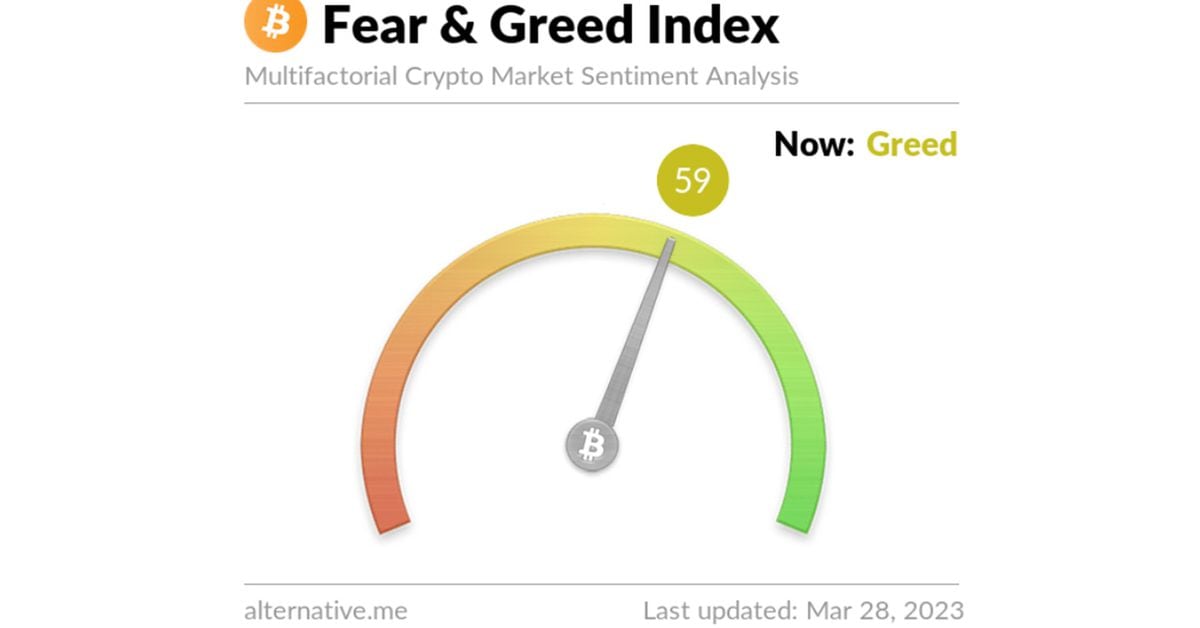
The Fear and Greed Index for the crypto market has pulled back to 59 from a nearly 18-month high of 68 reached one week ago, indicating that investor sentiment remains bullish despite growing regulatory crackdowns and macroeconomic fears. The index had been stuck in the "fear" and "extreme fear" territories for most of 2022. The recent rebound to "greed" came as crypto prices bounced back, with Bitcoin recently just shy of $27,000 after starting the year around $16,500. The US Commodity Futures Trading Commission (CFTC) is suing crypto exchange Binance and founder Changpeng Zhao on allegations the company knowingly offered unregistered crypto derivatives products in the US against federal law.