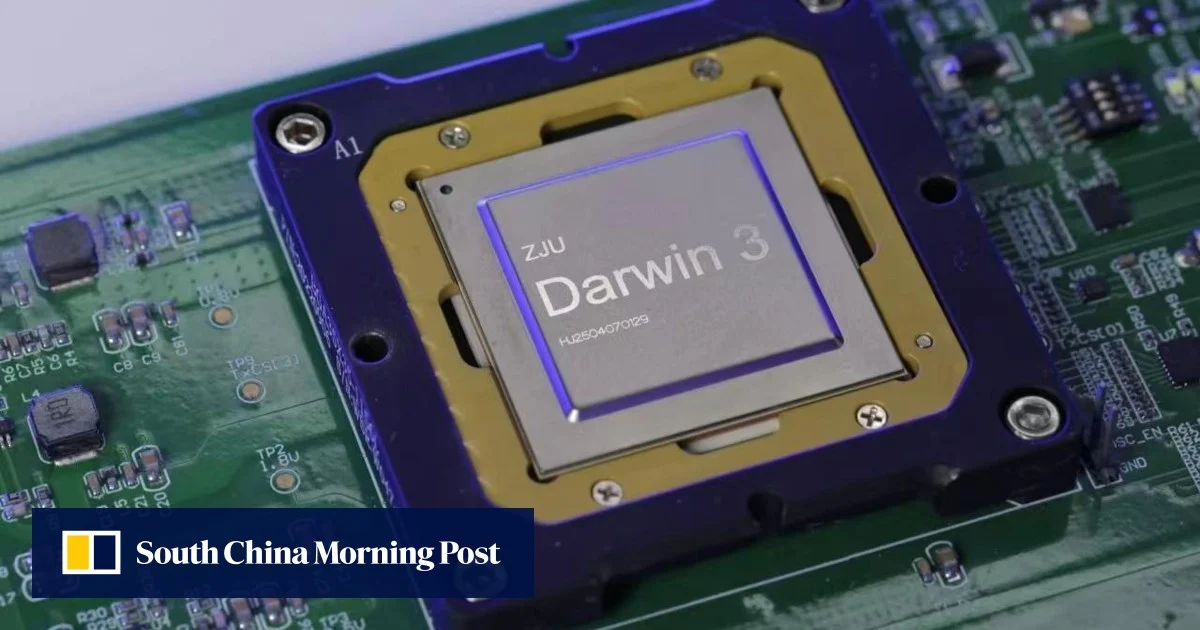
Chinese engineers at Zhejiang University have developed the 'Darwin Monkey,' the world's first brain-like computer with over 2 billion artificial neurons, potentially advancing human brain-inspired AI and capable of tasks like content generation and reasoning.
Researchers have developed a brain-inspired computing system using a self-organizing network of nanowires on electrodes, which achieved a 93.4% accuracy rate in identifying handwritten numbers. The system's unique training algorithm and memory storage within its physical structure set it apart from traditional computing approaches. This breakthrough could revolutionize AI applications, requiring less power and excelling in complex data analysis. The nanowire network shows promise for energy-efficient AI applications and has the potential to process complex, evolving data in real-time.
Researchers have developed a more powerful and energy-efficient memristor, based on the structure of the human brain, that combines data storage and processing. The new technology, made from nanocrystals of halogenated perovskite, is not yet ready for use as it is difficult to integrate with existing computer chips, but it has the potential for parallel processing of large amounts of data. The researchers are developing computer architectures inspired by the functioning of the human brain through new components that, like brain cells, combine data storage and processing.