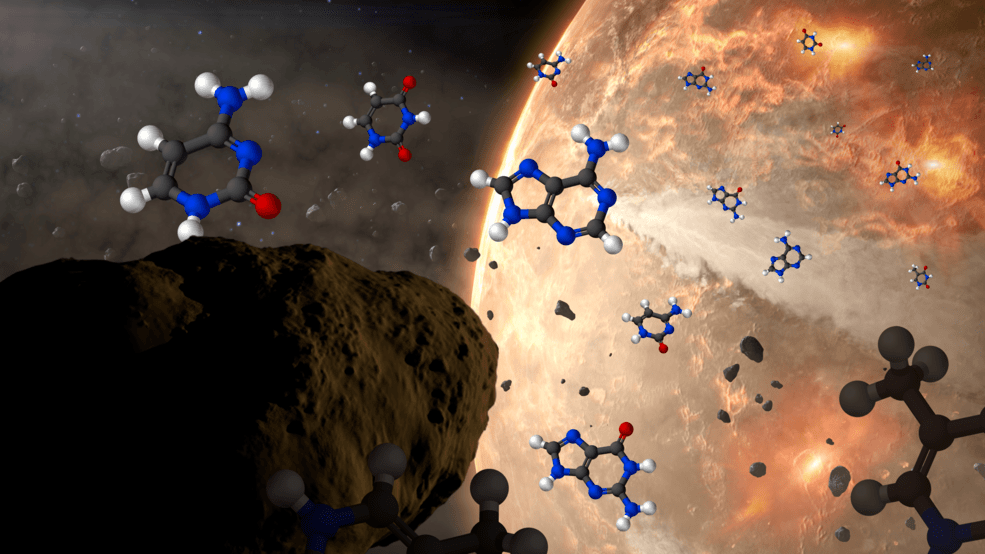
"Exploring the Dawn of Life's Possibility on Earth"
The journey from the Big Bang to the emergence of life is a complex process that required the Universe to cool and form stable atomic nuclei, atoms, and eventually the heavy elements necessary for life through stellar processes. Life on Earth likely began nearly 10 billion years after the Big Bang, possibly when the Universe was just a few percent of its current age. The formation of complex organic molecules in space and the conditions on rocky planets with water suggest that life could have arisen in the cosmos much earlier than previously thought, potentially within the first one or two billion years post-Big Bang. Scientists are exploring the origins of life through the study of amino acids in meteorites and the potential for metabolic processes to have started around hydrothermal vents, leading to self-replicating systems. The discovery of exoplanets and complex organic molecules in interstellar space further supports the possibility of life arising elsewhere in the Universe under the right conditions.