
Tag

Artificial Atoms

All articles tagged with #artificial atoms

science-and-technology2 years ago

Confirmed: Electron Pairing in Artificial Atoms Validates 50-Year-Old Quantum Prediction

Physicists have confirmed a quantum state predicted over 50 years ago by pairing electrons in an artificial atom on a superconductor, demonstrating the behavior of paired electrons and creating a basic version of superconductivity. This discovery has implications for advancing the understanding of superconductivity in nanoscale structures and its potential application in modern quantum computers.

science-and-technology2 years ago

"Long-awaited Quantum State Confirmed: Electrons in Artificial Atoms Form Pairs"

Researchers from the Department of Physics at Universität Hamburg have successfully observed a quantum state predicted over 50 years ago by Japanese theoreticians. By creating an artificial atom on a superconductor surface, the researchers paired electrons in a quantum dot, resulting in the smallest version of a superconductor. This breakthrough has implications for the development of nanoscale electronic devices and quantum computers.

quantum-computing2 years ago

Chiral Behavior Observed in Artificial Atoms

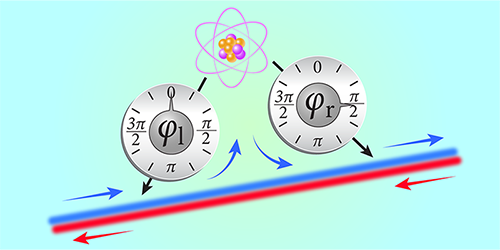
Researchers from the California Institute of Technology have developed a nonreciprocal device, an "artificial atom" made from a superconducting circuit, which can be coupled exclusively to either left- or right-moving signals in a microwave waveguide. This chiral design could be used in quantum networks to enable control over information flow between multiple artificial atoms coupled to a waveguide. The researchers achieved this by using additional superconducting artificial atoms as couplers between the emitter atom and the waveguide, and the relative phase between the modulations of the two couplers yielded the crucial phase difference that either let forward- or backward-propagating light pass through the waveguide.

science2 years ago

Scientists create synthetic benzene using caesium-based artificial atoms.

Researchers in the Netherlands have created 'artificial atoms' using caesium atoms on a semiconductor surface, which can form molecular orbitals similar to those in organic molecules. The artificial atoms could help researchers measure the energies of unstable molecular systems and gain insights into chemical energetics. The researchers arranged the caesium cations into a ring that had an electromagnetic potential analogous to that between atoms, and then arranged them into artificial molecules such as cis and trans butadienes and even artificial benzene. The researchers now want to use this to explore the fundamentals of chemical bonding.