
Researchers at Peking University have developed a high-precision analog computing system using RRAM chips that can rapidly solve matrix equations with 24-bit fixed-point accuracy, demonstrating scalability and potential applications in AI and communications.
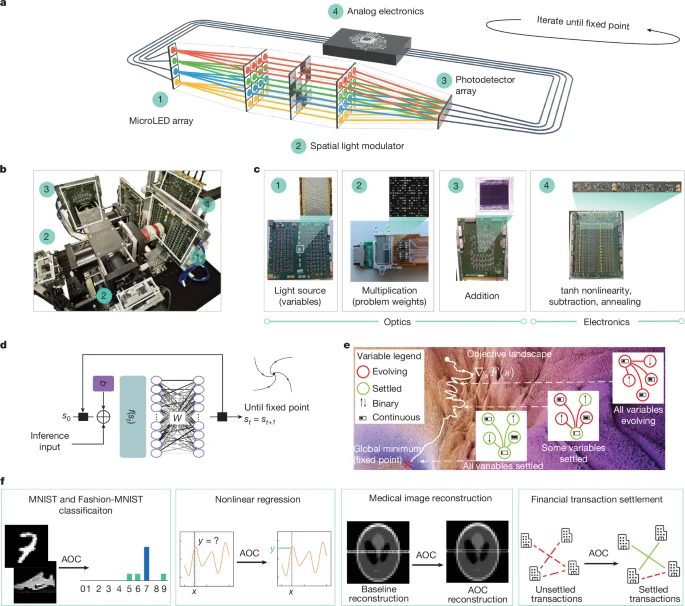
The article introduces the analog optical computer (AOC), a novel hardware platform that combines optical and electronic components to efficiently perform AI inference and combinatorial optimization tasks through fixed-point iterative processes, promising significant improvements in speed and energy efficiency over digital systems.
Researchers have built a proof-of-concept computer that uses running water instead of traditional logical circuitry processors to forecast future events via an approach called "reservoir computing." The computer uses solitary waves to process data at a higher speed and can forecast financial markets and certain kinds of human activity. The researchers plan to miniaturize the computer as a microfluidic processor, which could bring data science and machine learning to rural and remote communities worldwide.