
Arctic Ice Loss Since 1980 Visualized: 2050 Ice-Free Summers on the Horizon
TL;DR Summary
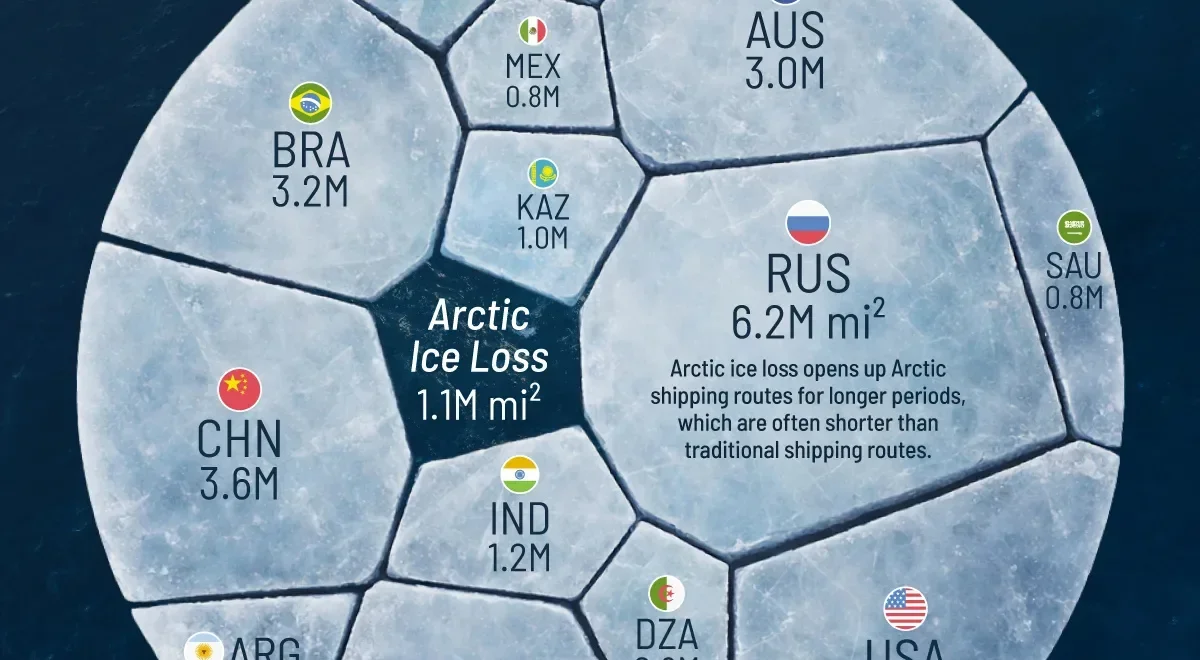
Since 1980, the Arctic’s minimum sea ice has shrunk by about 1.1 million square miles (roughly the size of Argentina), at a rate of about 12.2% per decade, with projections of ice-free summers by around 2050. The visualization (NASA/World Bank data) maps ice loss against country land areas, highlighting geopolitical and shipping shifts as Arctic routes open up. Global powers, including China with its Polar Silk Road and the Northern Sea Route, are preparing for a more accessible Arctic, while the region also holds significant oil potential (~412 billion barrels) and Greenland’s rare-earth reserves (~1.5 million metric tons).
- Arctic Ice Loss Since 1980 — Visualized at the Country Scale Visual Capitalist
- The Arctic’s Sudden Fever: Why 2026 Could Be the Year the Ice Doesn’t Recover Creative Learning Guild
Reading Insights
Total Reads
1
Unique Readers
1
Time Saved
33 min
vs 34 min read
Condensed
99%
6,641 → 98 words
Want the full story? Read the original article
Read on Visual Capitalist