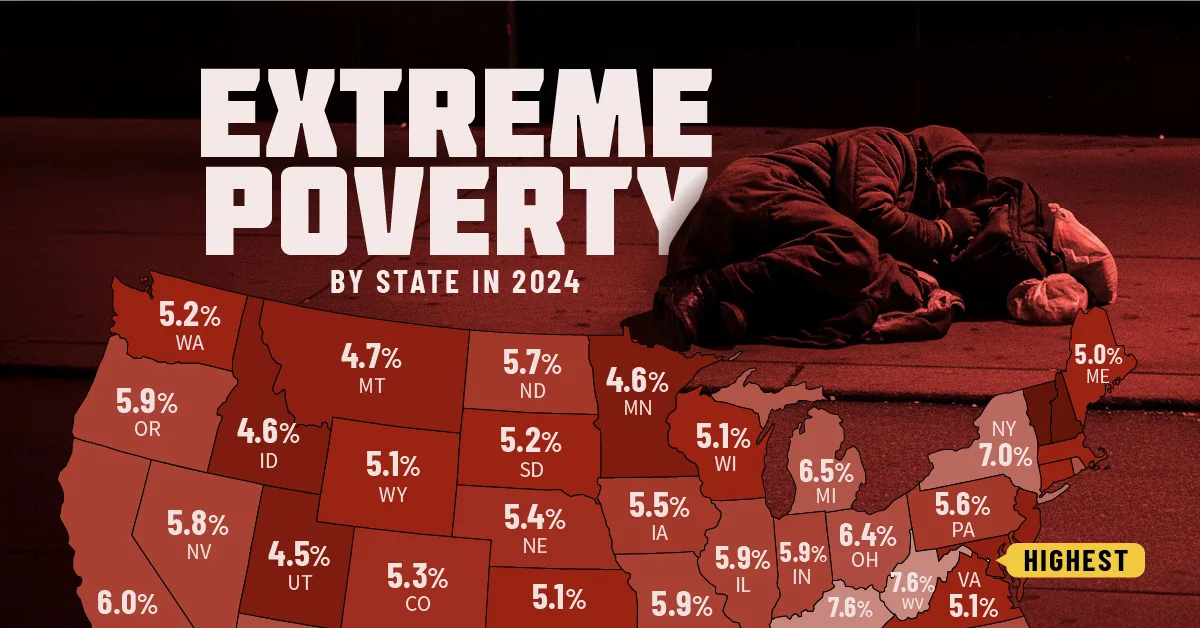
In 2024, 6% of the U.S. population, or 20.4 million people, live in extreme poverty, with Washington D.C. having the highest rate at 10.3%. Southern states like Louisiana, Mississippi, and New Mexico also have high poverty levels, while New Hampshire has the lowest at 3.9%, influenced by economic stability and education.
A study by GOBankingRates reveals significant disparities in how long a $1 million 401(K) would last across different states, with Mississippi offering the longest duration at nearly 23 years and Hawaii the shortest at just over 10 years. The study, which took into account living expenses and inflation, highlights the varying cost of living in the U.S. and suggests that a $1 million retirement fund may no longer be sufficient for a comfortable retirement. Despite this, the number of Americans with $1 million in their retirement accounts has increased, thanks to a strong stock market performance. The article also discusses savings strategies for different age groups to reach a $1 million retirement goal.
A GoBankingRates study reveals that $1 million in retirement savings can last significantly longer in states like Mississippi, where it could cover nearly 23 years of living expenses, compared to just over 10 years in Hawaii. The analysis, which considers costs such as housing, healthcare, and groceries, highlights the impact of location on retirement sustainability. Despite the ideal of a $1 million nest egg, most Americans, particularly Baby Boomers, have saved far less, with a median of $120,000 and nearly 30% of older adults having no retirement savings at all. This is concerning given that many retirements now exceed 25 years, and Americans believe they need $1.8 million for a comfortable retirement.