
JWST uncovers newborn supermassive black holes hidden in dense ionized cocoons
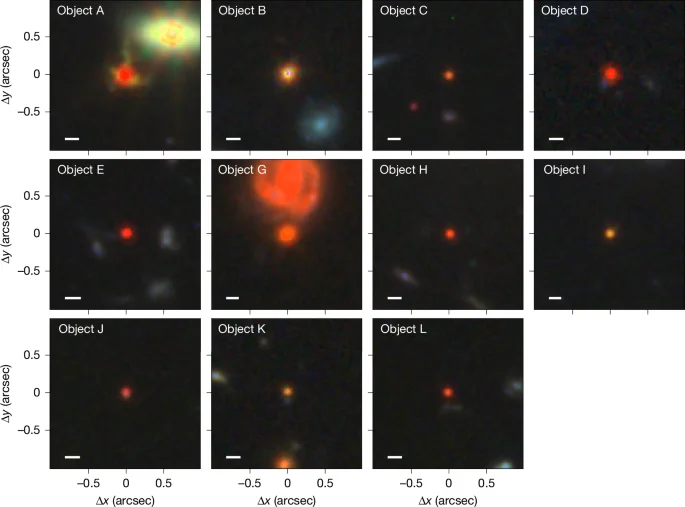
JWST/NIRSpec spectra of a sample of broad-line galaxies at z~3.4–6.7 show Hα line profiles broadened primarily by electron scattering in a dense, Compton-thick ionized gas cocoon, rather than by Doppler motions. Exponential line shapes fit the data better than Gaussians, implying very high electron column densities and compact scattering regions, which leads to lower inferred black-hole masses (~10^5–10^7 solar masses) than previously estimated. The objects are likely accreting near the Eddington limit but exhibit unusually weak X-ray and radio emission due to reprocessing by the cocoon. These are candidate young SMBHs enshrouded in dense gas, offering insight into the early growth of black holes in the universe. The study also integrates SED modeling to estimate host properties and discusses potential biases in virial mass estimates for this population.