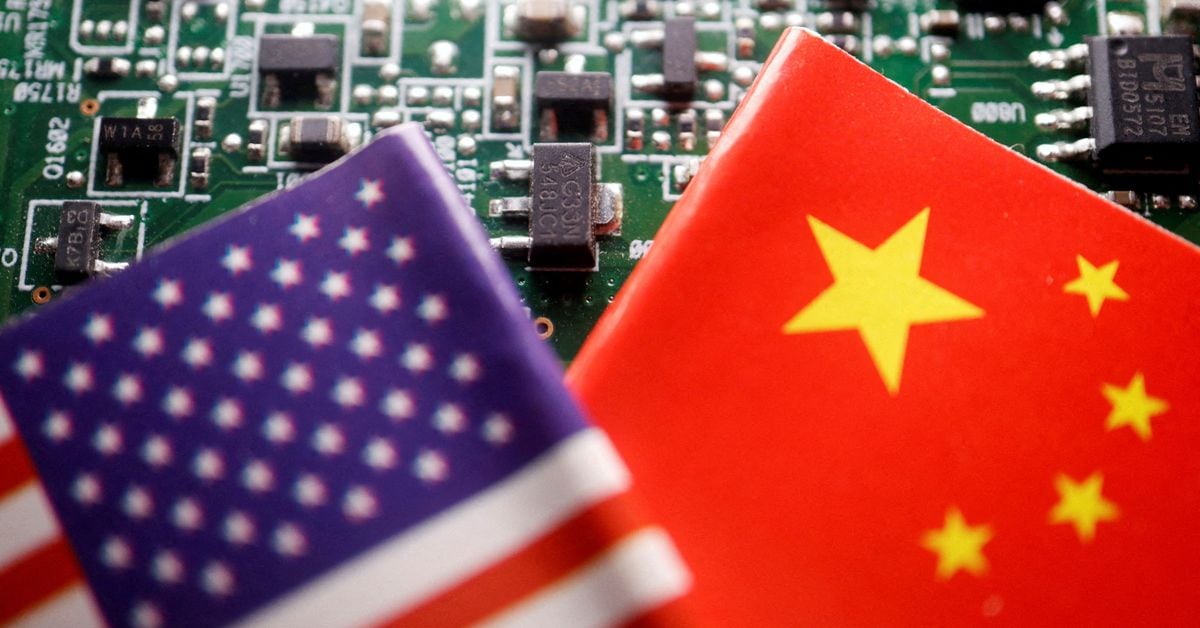
The European Union has called on China to quickly resolve issues related to export restrictions, emphasizing the importance of a prompt resolution to avoid escalating trade tensions.
US stock futures, particularly the tech-heavy Nasdaq 100, are set to decline sharply due to concerns over potential US export curbs on China and Donald Trump's comments on Taiwan. The Biden administration is considering tougher restrictions on advanced chip technology exports to China, affecting companies like Nvidia and ASML. Additionally, Trump's stance on Taiwan has impacted TSMC's shares. Despite these pressures, strong corporate earnings and upcoming economic data could influence market sentiment.
Chinese companies are purchasing US chipmaking equipment to produce advanced semiconductors, despite new export restrictions imposed by the US to hinder China's semiconductor industry. The restrictions aim to prevent Chinese chipmakers from acquiring US chipmaking tools for manufacturing advanced chips at or below the 14 nanometer node. However, importers can still buy the equipment by claiming it is for use on older production lines, making it difficult to verify its actual purpose. The report also reveals that China stockpiled equipment during the lag time between the US restrictions and similar moves by Japan and the Netherlands. The report suggests an annual evaluation of export controls on chipmaking equipment to China to address the gaps in the US rules.
China's announcement to curb exports of gallium and germanium, both critical metals used in various high-tech applications including silicon chips, highlights the escalating global competition for critical minerals and metals. This move is seen as a response to the U.S. Chips Act and increasing pressure on U.S. allies to restrict sales of sensitive microchip technology to China. While export controls will disrupt gallium and germanium markets in the short term, Western countries are expected to adapt over time. However, concerns remain about potential future restrictions on other critical metals, as China's dominance in the supply chain poses a significant challenge for the West's high-tech industrial base.
China has retaliated against US restrictions on its technology companies by imposing export controls on certain chipmaking materials, potentially disrupting the global semiconductor supply chain. The move comes as tensions between the US and China continue to escalate in the ongoing trade war, with both countries imposing tariffs and restrictions on various industries. The export curbs by China could have significant implications for the semiconductor industry, as it heavily relies on Chinese suppliers for critical materials.
The Netherlands is set to impose tougher export controls on shipments of ASML's advanced semiconductor equipment to China, following pressure from the United States. The move comes as the US seeks to limit China's access to key technologies amid concerns over intellectual property theft and national security. ASML, a Dutch company and a global leader in lithography systems, has been a key supplier to China's semiconductor industry, but the new restrictions could impact its business and disrupt China's efforts to develop its domestic chip manufacturing capabilities.