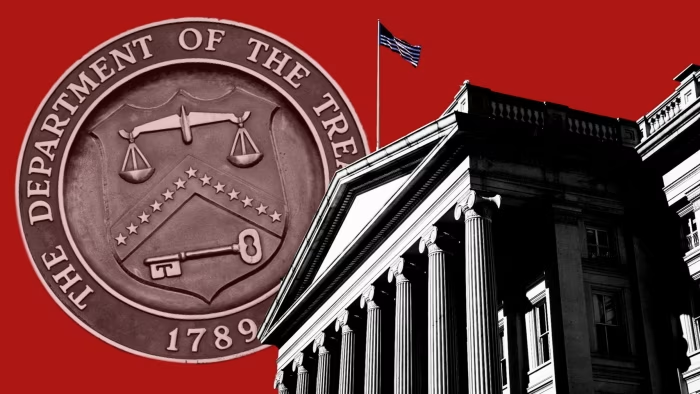
Investors are increasingly pouring into tokenised Treasury and money market funds, which offer faster, cheaper trading and yield compared to stablecoins, driven by crypto traders and institutional interest, with the market expected to grow significantly.
In 2023, the United States led the world in enforcing crypto regulations, with the SEC taking significant legal actions against major industry players, including Binance and its former CEO. While other countries have also been busy establishing formal laws for digital currencies, the U.S. stands out for its aggressive approach, often described as "regulation by enforcement." This has led to substantial penalties and fines for crypto companies, with some industry participants threatening to move their operations overseas. Despite this, the U.S. has yet to pass specific legislation tailored for the crypto industry. Meanwhile, the European Union is set to fully implement its Markets in Crypto-Assets legislation in 2024, and individual European countries are also advancing their regulatory frameworks. In Asia, Singapore and Hong Kong are taking steps towards clear crypto regulations, and the Middle East, particularly the UAE, is creating favorable conditions for the crypto industry.
Industry influencers predict a 'crypto spring' in 2024, driven by clear regulations and the integration of AI with blockchain technology. Stablecoins are expected to become a true digital currency, with increased adoption and regulatory support from the UK and EU. Traditional finance is anticipated to further merge with digital assets, potentially with the approval of Bitcoin ETFs. Meanwhile, the sophistication of crypto criminals is likely to grow, necessitating advanced law enforcement strategies. The blockchain infrastructure is set to expand, with real-world asset tokenization and the tokenization of other assets gaining momentum. Additionally, falling interest rates and regulatory clarity are expected to boost confidence in web3, with blockchain gaming and the open metaverse attracting significant investment. AI's evolution is predicted to enhance the use of blockchain networks, particularly in computing, data, and learning models.