
Tag

Archival Storage

All articles tagged with #archival storage

Microsoft's Glass Storage Aims for a 10,000-Year Data Archive
technology6 days ago

Microsoft's Glass Storage Aims for a 10,000-Year Data Archive

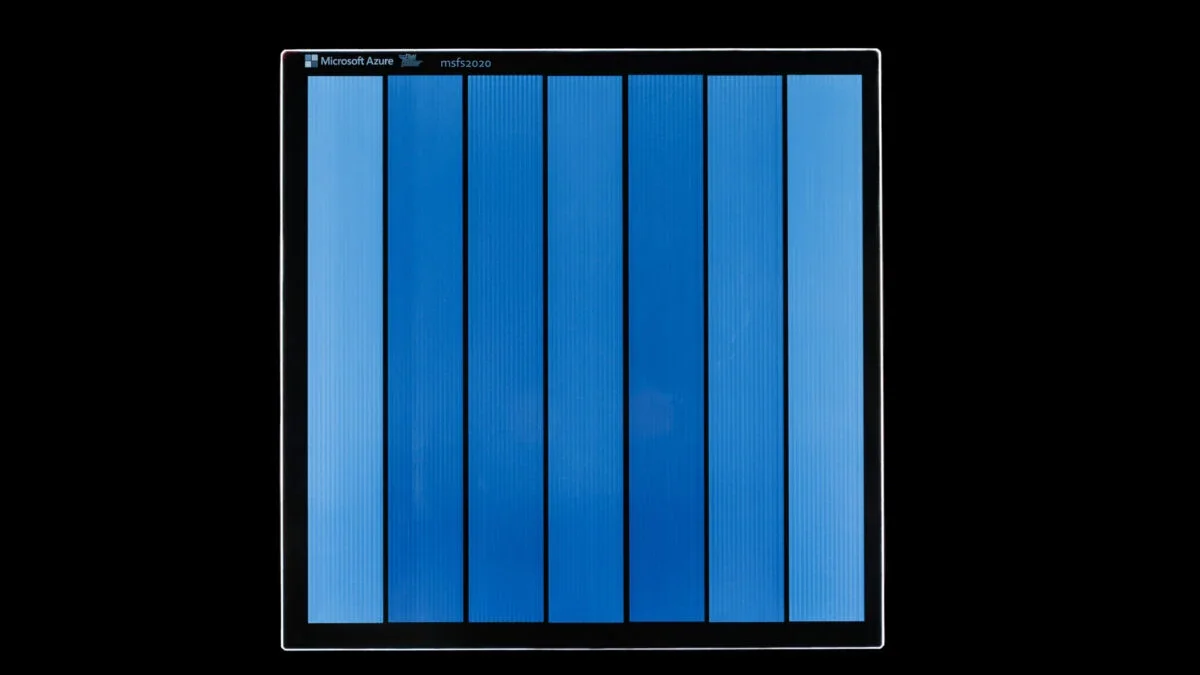
Microsoft's Project Silica demonstrates storing data in laser-etched borosilicate glass via phase-voxel encoding across multiple layers, yielding up to 4.8 terabytes on a 0.08-inch-thick chip. The four-dimensional approach (voxel plus light phase) promises a durable archival medium with a claimed 10,000-year lifespan, addressing the digital dark age by offering a cost-effective, long-term alternative to magnetic media for libraries and archives.
Glass memory: femtosecond-laser archival storage achieves ultra-dense, millennia-durable data
technology7 days ago

Glass memory: femtosecond-laser archival storage achieves ultra-dense, millennia-durable data

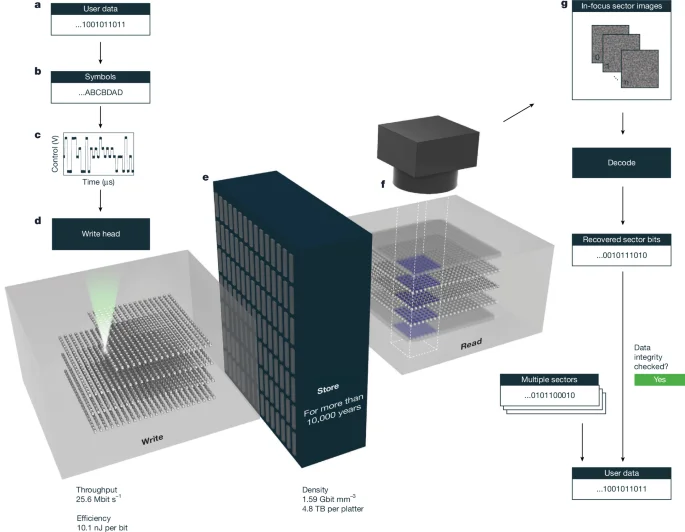
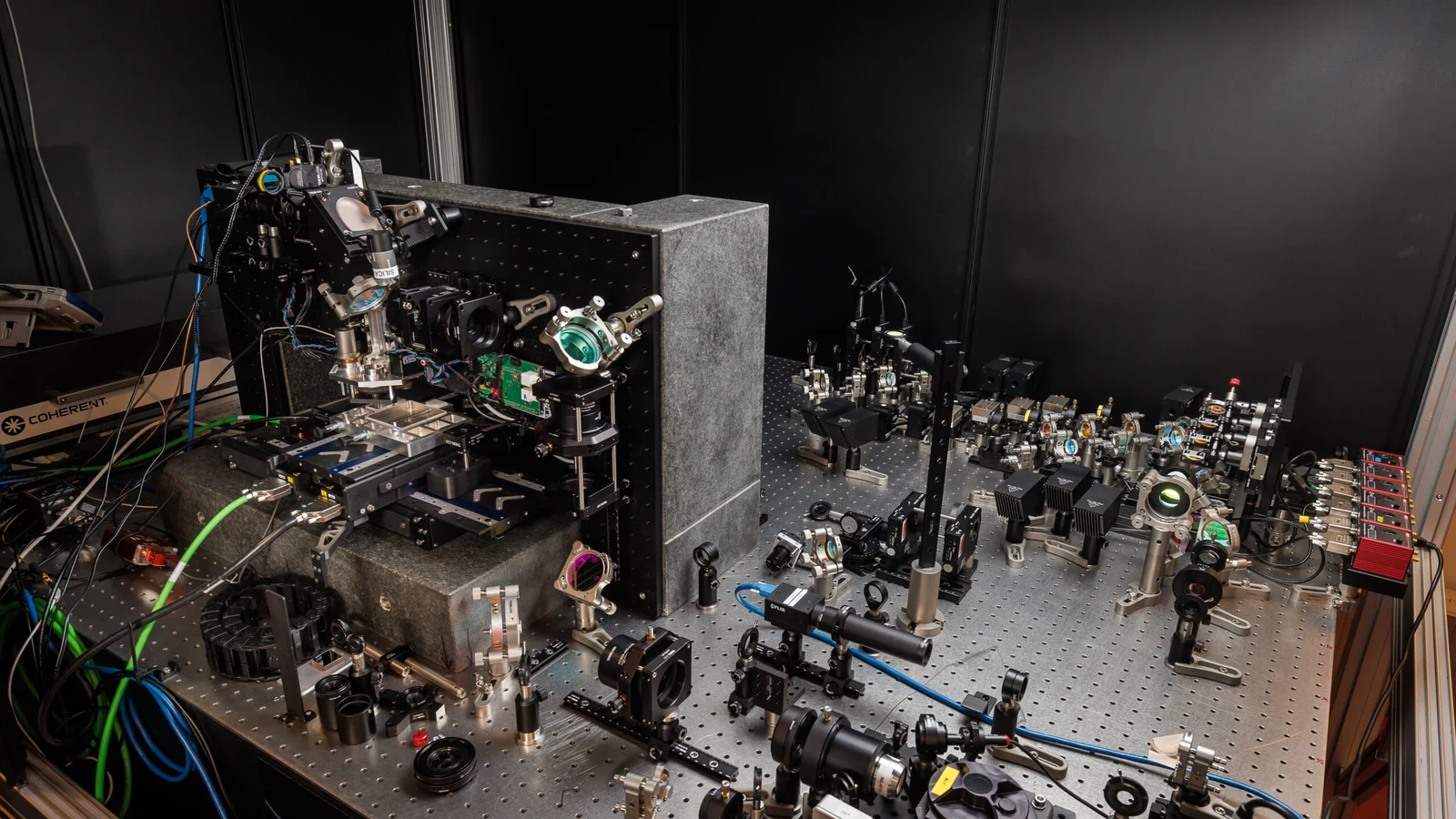
Microsoft Research’s Silica demonstrates an end-to-end optical archival storage system that writes data into glass using two voxel regimes. Birefringent voxels in fused silica (pseudo-single-pulse) yield 1.59 Gbit/mm^3 density, about 4.84 TB per platter, at 25.6 Mbit/s per beam with 10.1 nJ/bit; phase voxels in borosilicate glass (single-pulse) reach 0.678 Gbit/mm^3, about 2.02 TB per platter, at 18.4 Mbit/s and 8.85 nJ/bit. A multibeam setup attains 65.9 Mbit/s. Data are read with wide-field microscopy and decoded by a CNN-based symbol-inference pipeline plus LDPC error correction, enabling error-free recovery across billions of voxels. Accelerated ageing tests project data lifetimes exceeding 10,000 years at room temperature. The fully automated write/read/decode chain, plus scaling directions (higher NA, more beams, different glasses), position Silica as a durable, high-density archival technology for the digital age.

Microsoft Demonstrates Glass Storage for 10,000-Year Data Durability
technology7 days ago

Microsoft Demonstrates Glass Storage for 10,000-Year Data Durability

Microsoft Research’s Project Silica shows data can be written to borosilicate glass with femtosecond lasers, achieving up to 4.84 TB per 12×12 cm slab and potentially 10,000-year stability at room temperature. Data is encoded and read using voxel-based methods (birefringence or refractive-index changes) plus phase-contrast microscopy interpreted by AI, with LDPC error correction. Current writes run at 66 Mbps with four lasers, expandable to more lasers, but large-scale deployment would require many machines. The approach offers durable, energy-free storage and rapid retrieval, though commercialization remains distant and practical scale remains a challenge.