OpenAI has introduced new personality customization options for ChatGPT, allowing users to adjust the bot's warmth, enthusiasm, response organization, and emoji use, enhancing user interaction while maintaining safety and mental health considerations.
The article outlines seven strategies to optimize ChatGPT as a personal productivity tool, including creating master prompts, customizing system prompts, organizing project folders, using canvases for editing, setting custom instructions, building specialized GPTs, and integrating ChatGPT into daily routines to automate tasks, improve content quality, and enhance workflow efficiency.
OpenAI has released GPT-OSS, a free, open-weight AI model available in 120-billion and 20-billion-parameter versions that can run on laptops and be customized for various tasks, marking their first open model release in over six years with a focus on safety and broad accessibility.
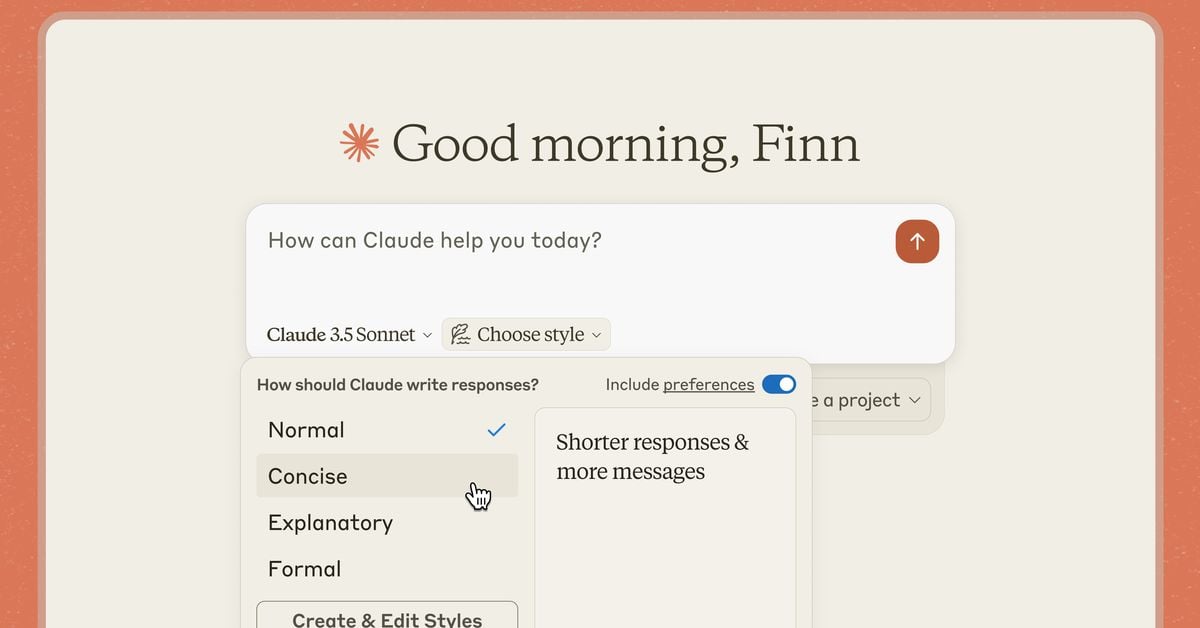
Anthropic has introduced a new feature to its Claude AI assistant, allowing users to customize the chatbot's writing style to match their own or choose from preset options like Formal, Concise, and Explanatory. This update aims to personalize interactions, making them more natural for specific tasks such as technical writing or professional emails. Users can upload sample content to train Claude in their preferred style, similar to features offered by OpenAI's ChatGPT and Google's Gemini.
OpenAI is focusing on serving enterprise customers with new customization options for its GPT-4 API, including third-party platform connections, saving fine-tuned models, and a new user interface for performance comparison. The company's COO sees 2024 as the "year of the enterprise" for AI applications, emphasizing real business results. OpenAI also announced assisted fine-tuning and a partnership with Weights & Biases, aiming to tailor GPT-4 models to specific organizational needs.