
Engineered MagLOV proteins enable in vivo quantum sensing with MRI-like imaging
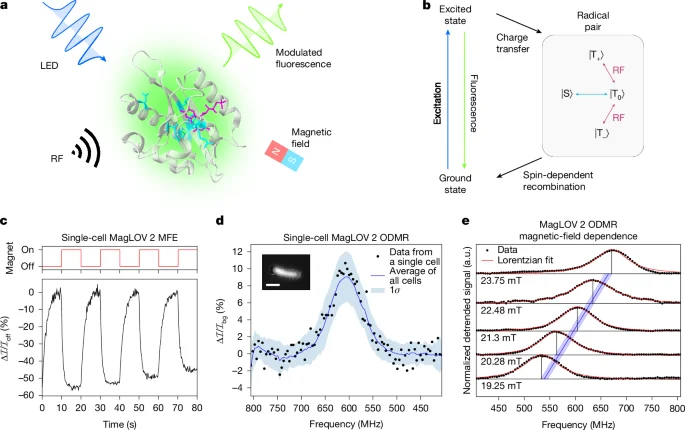
Researchers engineered magneto-sensitive fluorescent proteins (MagLOV) that show optically detected magnetic resonance in living cells at room temperature, with single-cell sensitivity and ~10% ODMR contrast. Through directed evolution, variants with tunable magnetic-field responses were created, supporting multiplexed readout, lock-in detection, and spatial localization of fluorescence using magnetic-field gradients (fluorescence MRI). MagLOV reports are also sensitive to the local spin environment (e.g., gadolinium), enabling in situ sensing of cellular microenvironments. Collectively, this work demonstrates a programmable, endogenously expressible quantum-sensing platform in biology with broad imaging and sensing applications.
- Quantum spin resonance in engineered proteins for multimodal sensing Nature
- Quantum tools set to transform life science, researchers say Phys.org
- Oxford Team Engineer Quantum-enabled Proteins, Opening a New Frontier in Biotechnology The Quantum Insider
- Quantum proteins engineered for magnetic sensing Longevity.Technology
- Engineered Proteins Use Quantum Spin Resonance for Biological Sensing in Bacteria Genetic Engineering and Biotechnology News
Reading Insights
0
4
54 min
vs 55 min read
99%
10,949 → 87 words
Want the full story? Read the original article
Read on Nature