
"Climate-Smart Crop Management: Optimizing Practices for Sustainable Production"
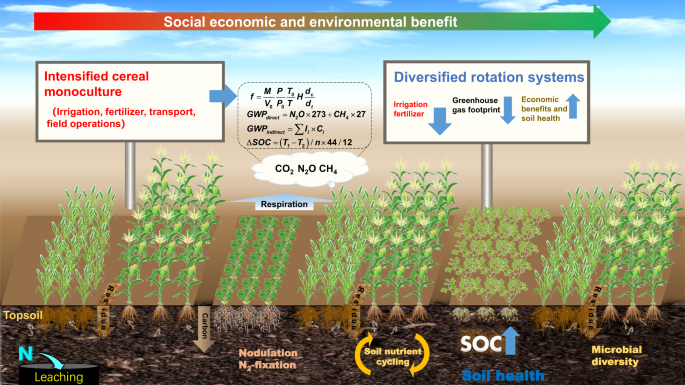
A 6-year field study in the North China Plain demonstrated that diversified crop rotations, including cash-crops and legumes, can significantly increase food production, enhance farmers' income, and improve soil health while reducing net greenhouse gas emissions. The study found that rotations incorporating crops like sweet potato, peanut, and soybean increased annual equivalent yield, economic benefit, and protein yield compared to traditional wheat-maize double-cropping. These diversified systems also led to a reduction in N2O emissions, increased soil carbon sequestration, and enhanced soil microbial diversity, contributing to a more sustainable agricultural model that could guide similar regions globally.