
Shape-matched porous microlattices enable full-surface, high-density electrophysiology in neural organoids
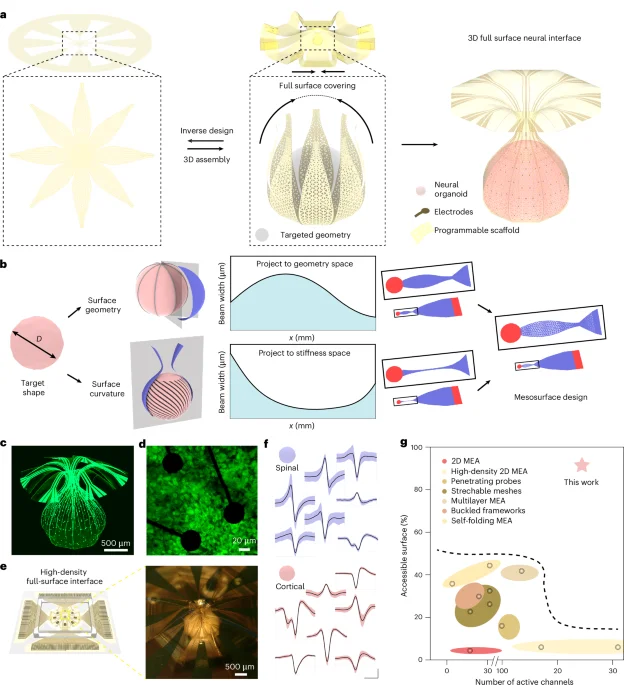
Researchers report a shape-conformal, porous 3D microlattice that self-assembles around neural organoids to provide nearly full surface coverage with dense, low-impedance microelectrodes (up to 240 channels across 91% of a spherical organoid). The inverse-design buckling approach creates tunable 3D geometries that support high-resolution electrophysiology, stimulation, and simultaneous imaging, while preserving diffusion through the porous scaffold. Demonstrated with human cortical and spinal organoids, the system enables 3D spatial mapping of activity, longitudinal monitoring, pharmacology tests, optogenetic modulation, and disease-phenotype modeling, with versatility in shapes (spherical, hexagonal prisms, cubes) and growth-in-place integration for enhanced organoid interfacing and assembloid engineering.
- Shape-conformal porous frameworks for full coverage of neural organoids and high-resolution electrophysiology Nature
- Electronic Mesh Wraps Around Mini-Brains to Eavesdrop on Neural Circuits Neuroscience News
- Cracking the Brain’s Code: New Sensor Wraps the Human Mind in 3D Insight The University of North Carolina at Chapel Hill
- Next-Generation Bioelectronics Interface with Living ‘Mini Brains’ BIOENGINEER.ORG
- Shape-conforming 3D bioelectronic mesh maps 91% of lab-grown mini brain activity Interesting Engineering
Reading Insights
0
2
57 min
vs 58 min read
99%
11,444 → 97 words
Want the full story? Read the original article
Read on Nature